
Lesson
Draw how it feels.
AColorful ArtObserve a surface and choose marks that suggest its texture.
Texture · Use observation and marks to suggest how things feel.
Question
How can a smooth piece of paper show something rough?
 How can a smooth piece of paper show something rough?
Answer
Artists use lines, dots, and other marks to suggest texture. A picture can help us imagine how a surface feels, even when the paper itself stays smooth.
 Artists use lines, dots, and other marks to suggest texture. A picture can help us imagine how a surface feels, even when the paper itself stays smooth.
History
Around 1925, Max Ernst made drawings using frottage, or rubbing over textured surfaces beneath paper. Prints based on these drawings appeared in his Natural History portfolio in 1926.
 Around 1925, Max Ernst made drawings using frottage, or rubbing over textured surfaces beneath paper. Prints based on these drawings appeared in his Natural History portfolio in 1926.
Example
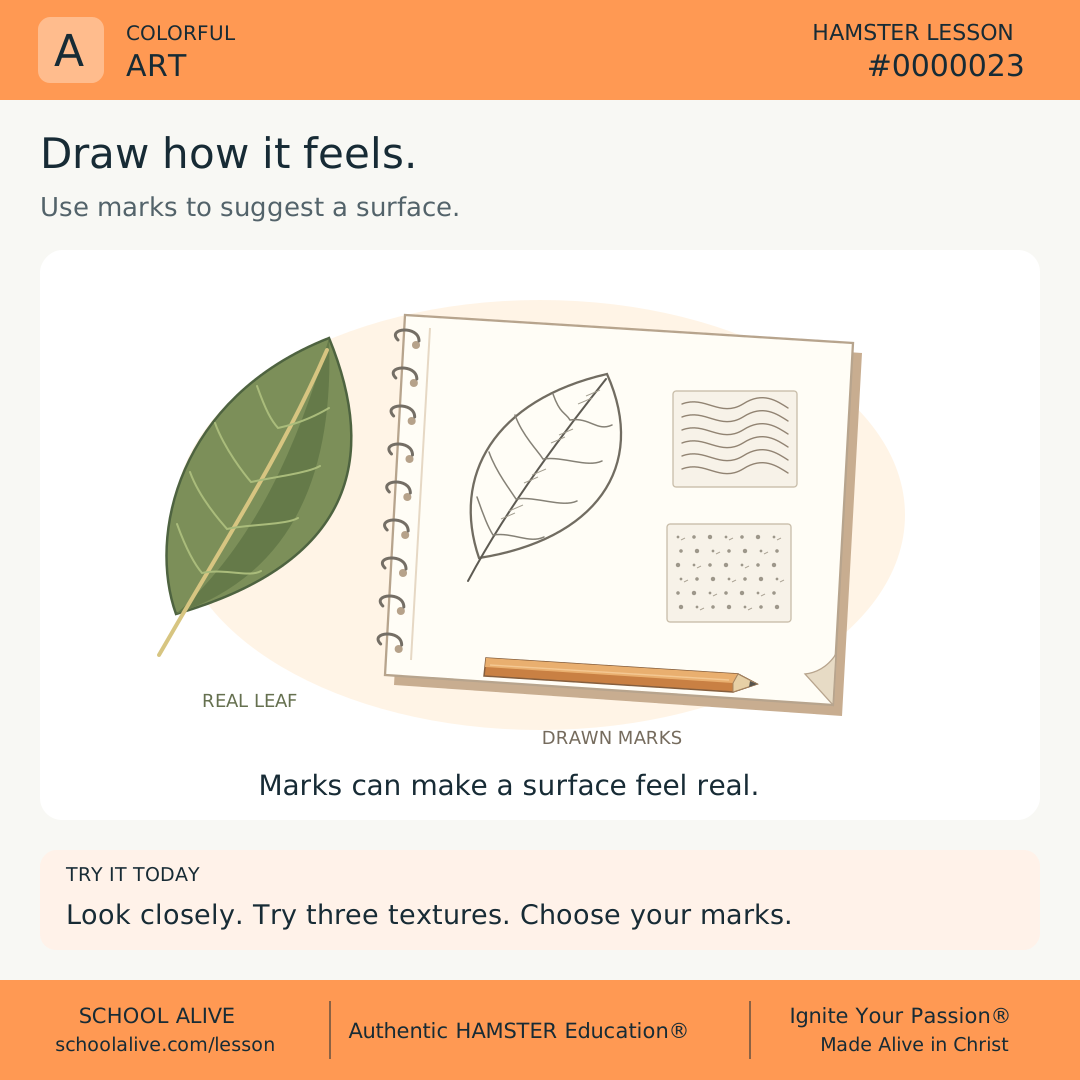
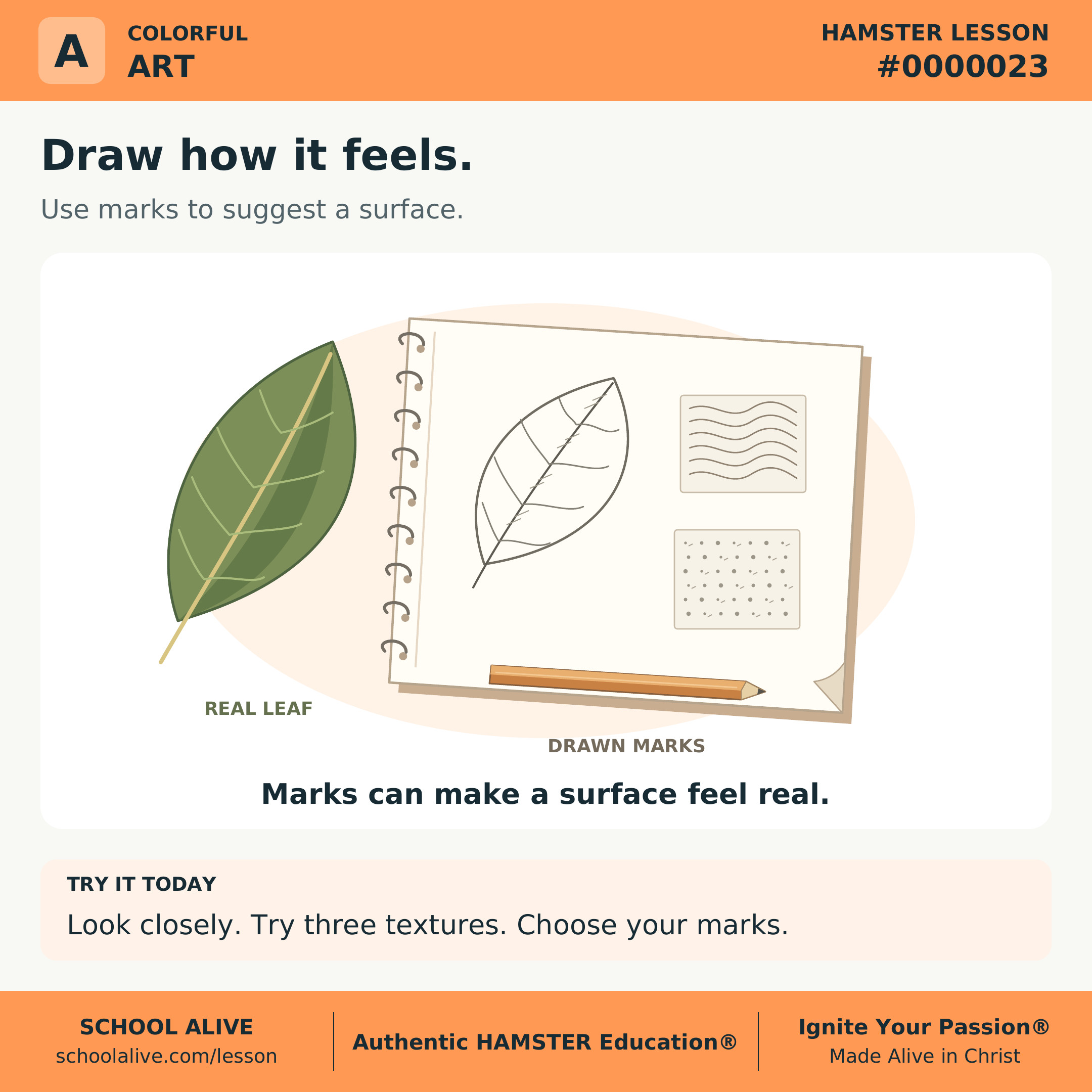
Draw a leaf outline twice. Leave one empty, then add branching vein lines inside the other. Compare which version gives you more clues about the leaf’s surface.
 Draw a leaf outline twice. Leave one empty, then add branching vein lines inside the other. Compare which version gives you more clues about the leaf’s surface.
Insight
Useful marks begin with careful looking. Notice the direction and spacing of details, then choose a few that help someone recognize the surface.
 Useful marks begin with careful looking. Notice the direction and spacing of details, then choose a few that help someone recognize the surface.
Connection
Illustrators use texture to make fur look soft, stone look rough, or cloth look woven. Observing these details can deepen our appreciation for the variety in God’s creation.
 Illustrators use texture to make fur look soft, stone look rough, or cloth look woven. Observing these details can deepen our appreciation for the variety in God’s creation.
Challenge
Choose three surfaces you can examine. Draw a small sample of marks for each on paper. Ask someone to match the samples to the surfaces, then improve one sample.
 Choose three surfaces you can examine. Draw a small sample of marks for each on paper. Ask someone to match the samples to the surfaces, then improve one sample.
Dive deeper
Context
Art invites us to notice the ordinary world closely. A leaf, a woven sleeve, or a smooth cup can offer ideas for drawing. Today we explore texture with simple materials and deliberate observation.
Understand the idea
Actual texture is a surface quality we can feel. Visual texture is the suggestion of that quality in an image. A drawing of bark may look rough even when its paper feels smooth. Looking closely helps us choose marks that describe the object.
Try different marks before choosing one. A row of tiny loops might suggest a knitted sleeve. Branching lines might suggest leaf veins. Their spacing and direction matter. For our practice, keep the outline the same so you can compare what changing the marks does to the image.
A rubbing records some of the raised details beneath paper. A drawing lets you select and arrange details by hand. Compare both approaches with the object itself. Ask a partner what your marks suggest, then adjust one small area. You can learn from the response while making your own artistic decisions.
A small texture sampler
- Choose three familiar surfaces you may handle, such as a fallen leaf, corrugated cardboard, and fabric. Look at each closely. Describe it with one word.
- Divide a sheet into three boxes. Draw marks in each box to suggest one surface. Try changing the length, spacing, or direction of the marks. Younger learners can begin with a few large marks.
- For an optional comparison, place a fallen leaf beneath thin paper and rub gently with the side of a crayon. Keep the marks on the paper. Compare this rubbing with your drawn version.
- Ask someone to match your three samples to the objects. Choose one sample and revise a small area to make the surface clearer. Older learners can use that texture in a drawing of an everyday object.
Discuss together
- Which marks helped someone recognize a surface?
- How does looking again at the object change what you decide to draw?
Introducing Microlessons
One idea. Seven steps. A practical discovery.
Begin with a question and a clear answer. Explore the history, an example, and a deeper insight. Connect the idea to everyday life, then put it into practice.
Read on your own or talk it through together. Each prepared edition includes a shareable image, concise text, and a one-page PDF.
How the 7 steps work
Each lesson moves from curiosity to understanding to practical action. Here is what each step contributes.
Question
Opens a question worth exploring and gives the lesson a clear purpose.
Answer
Gives a clear starting point that the rest of the lesson helps us understand.
History
Shows how people encountered the idea and how their discoveries shaped what we know.
Example
Makes the idea concrete through a situation, demonstration, or worked example.
Insight
Draws out the deeper principle so we understand why the idea matters.
Connection
Connects the idea to other disciplines, our faith, and everyday life.
Challenge
Turns understanding into action through something to try, practice, or explain.