
Lesson
Different pieces. Same amount.
MCalculated MathematicsRecognize the same amount in different forms.
Number sense · Explore equivalent fractions: different ways to name the same part of a whole.
Question
How can one-half, two-fourths, and four-eighths all be equal?
 How can one-half, two-fourths, and four-eighths all be equal?
Answer
They are equivalent fractions: different ways to describe the same amount when we start with the same-sized whole.
 They are equivalent fractions: different ways to describe the same amount when we start with the same-sized whole.
History
Long before calculators, people used fractions to share food, measure land, and solve practical problems. The ancient Egyptian Rhind Mathematical Papyrus includes problems involving fractions.
 Long before calculators, people used fractions to share food, measure land, and solve practical problems. The ancient Egyptian Rhind Mathematical Papyrus includes problems involving fractions.
Example
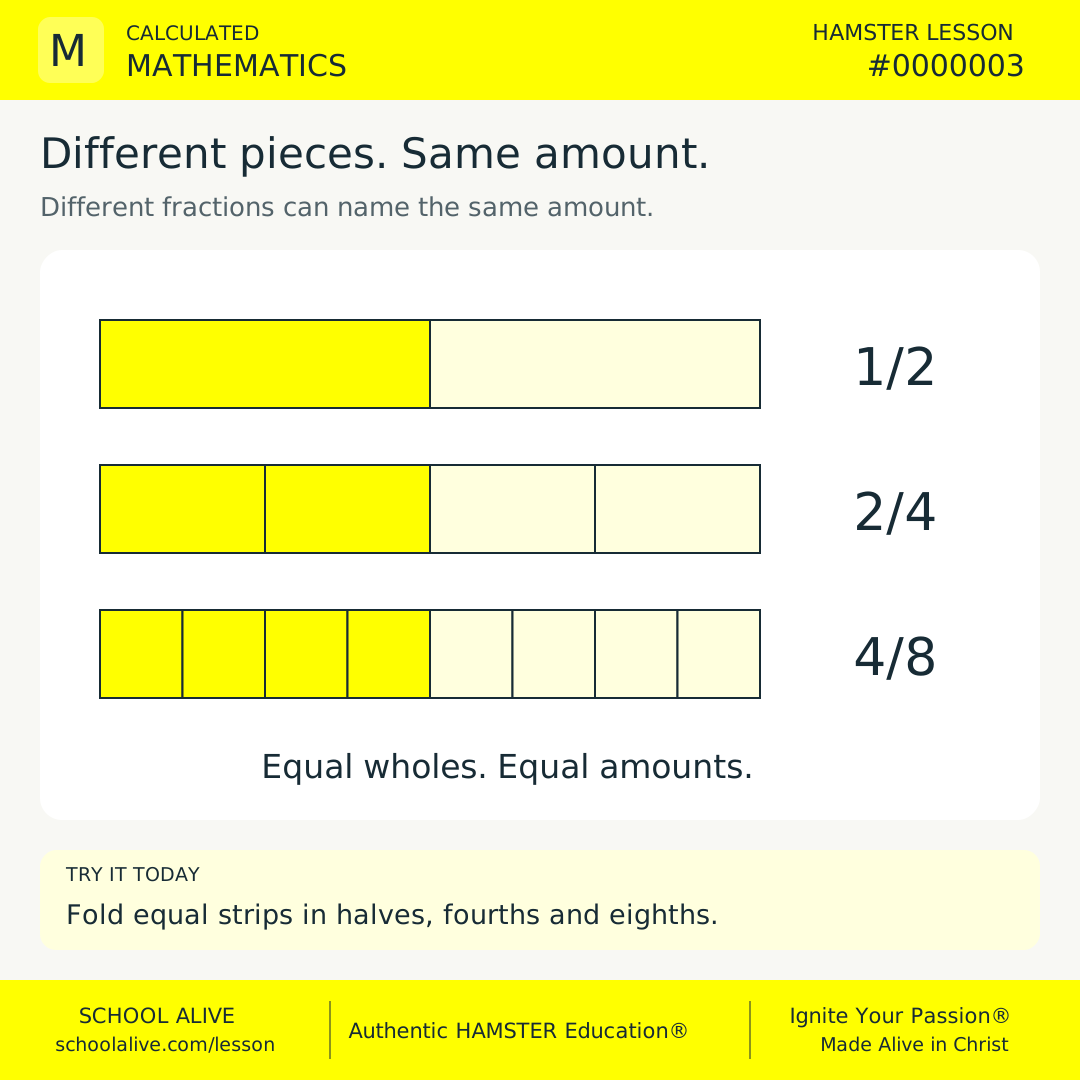
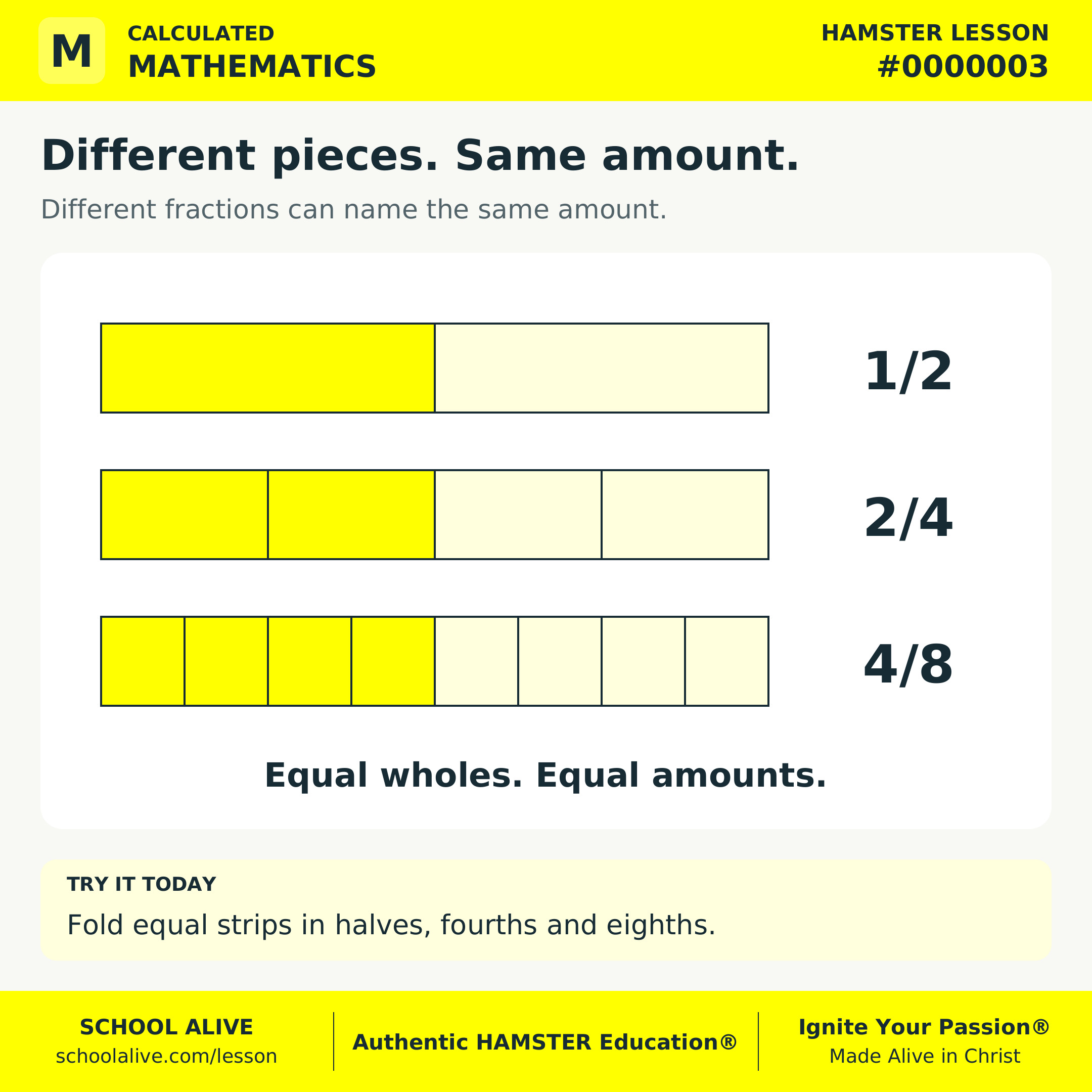
Divide a rectangle into two equal pieces and shade one. Divide an identical rectangle into four equal pieces and shade two. Each picture shows half of the whole.
 Divide a rectangle into two equal pieces and shade one. Divide an identical rectangle into four equal pieces and shade two. Each picture shows half of the whole.
Insight
Multiplying a fraction's numerator and denominator by the same positive whole number preserves its value: 1/2 = 2/4 = 4/8. More, smaller pieces can represent the same amount.
 Multiplying a fraction's numerator and denominator by the same positive whole number preserves its value: 1/2 = 2/4 = 4/8. More, smaller pieces can represent the same amount.
Connection
Equivalent fractions help us compare quantities, adjust recipes, and measure accurately. Always check the whole: half of a small pizza is not the same amount of food as half of a large pizza!
 Equivalent fractions help us compare quantities, adjust recipes, and measure accurately. Always check the whole: half of a small pizza is not the same amount of food as half of a large pizza!
Challenge
Cut three equal paper strips. Fold them into halves, fourths, and eighths. Shade half of each and label the fractions. Line them up to check the shaded lengths. Explain why the amounts match. Can you also show 3/6?
 Cut three equal paper strips. Fold them into halves, fourths, and eighths. Shade half of each and label the fractions. Line them up to check the shaded lengths. Explain why the amounts match. Can you also show 3/6?
Dive deeper
Context
A fraction describes a number using equal parts. To compare pictures of fractions fairly, first decide what counts as one whole and make sure the parts within each whole are equal.
Understand the idea
When each half is split into two equal parts, the whole has four parts and the shaded half has two. The number of pieces changes, but the shaded amount does not: 1/2 = 2/4.
Multiplying the numerator and denominator by the same nonzero number preserves a fraction’s value. For example, 2/3 × 2/2 = 4/6 because 2/2 is one. Adding the same number to both does not generally work: 1/2 and 2/3 are different numbers.
Try a second representation
- Draw two equal-length number lines from 0 to 1. Mark halves on the first and sixths on the second.
- Locate 1/2 and 3/6. Explain why they land at the same point.
- Show 2/3 and 4/6 with equal paper strips. Then explain why half of a larger strip can be longer than half of a smaller strip.
Discuss together
- What must stay the same when you compare shaded fraction models?
- How could you convince someone that 2/3 and 4/6 are equal without using a calculator?
Introducing Microlessons
One idea. Seven steps. A practical discovery.
Begin with a question and a clear answer. Explore the history, an example, and a deeper insight. Connect the idea to everyday life, then put it into practice.
Read on your own or talk it through together. Each prepared edition includes a shareable image, concise text, and a one-page PDF.
How the 7 steps work
Each lesson moves from curiosity to understanding to practical action. Here is what each step contributes.
Question
Opens a question worth exploring and gives the lesson a clear purpose.
Answer
Gives a clear starting point that the rest of the lesson helps us understand.
History
Shows how people encountered the idea and how their discoveries shaped what we know.
Example
Makes the idea concrete through a situation, demonstration, or worked example.
Insight
Draws out the deeper principle so we understand why the idea matters.
Connection
Connects the idea to other disciplines, our faith, and everyday life.
Challenge
Turns understanding into action through something to try, practice, or explain.