
More word-for-word → more thought-for-thought.
Approximate order. AMP includes added explanations.
Question
Must everything be settled before we can have peace?
Answer
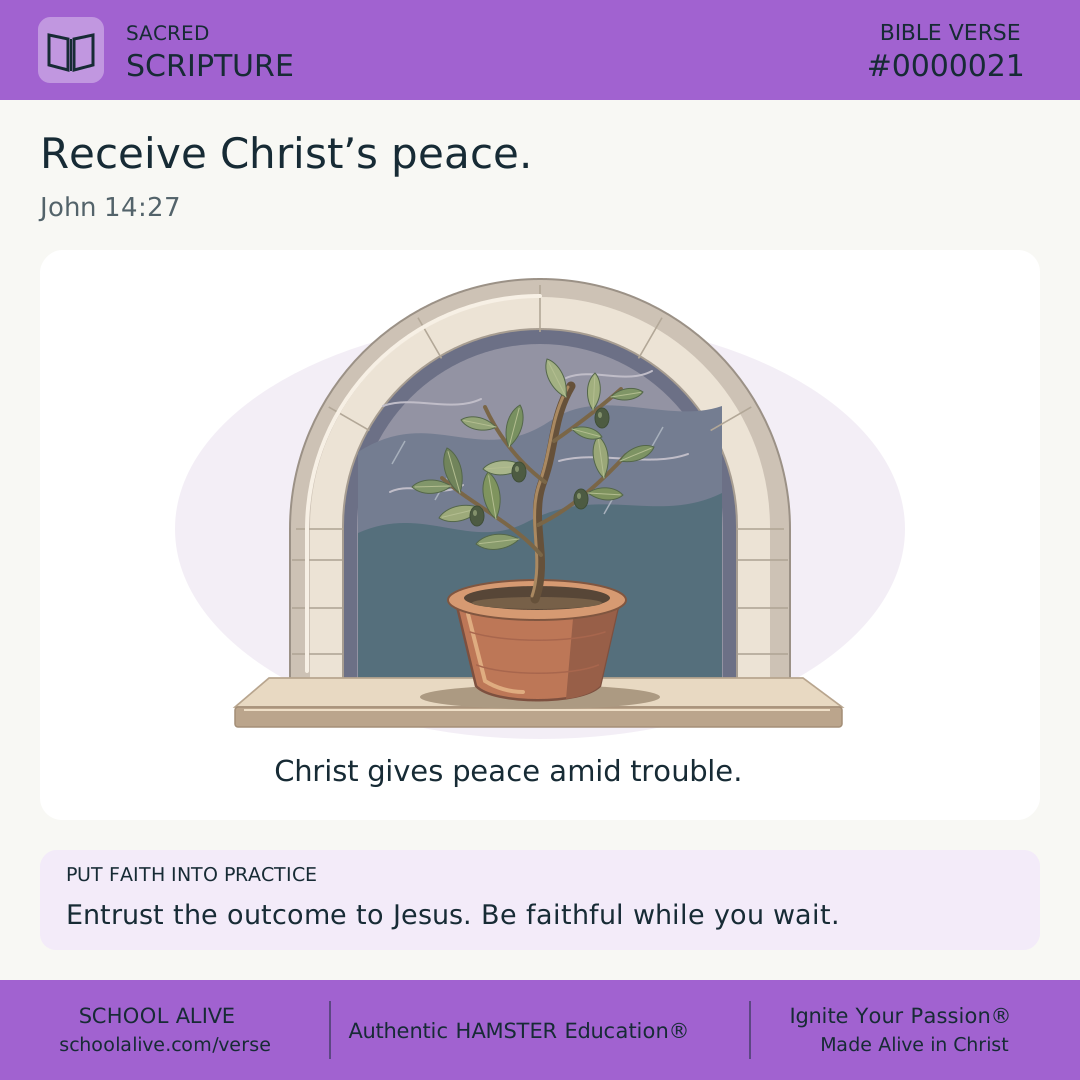
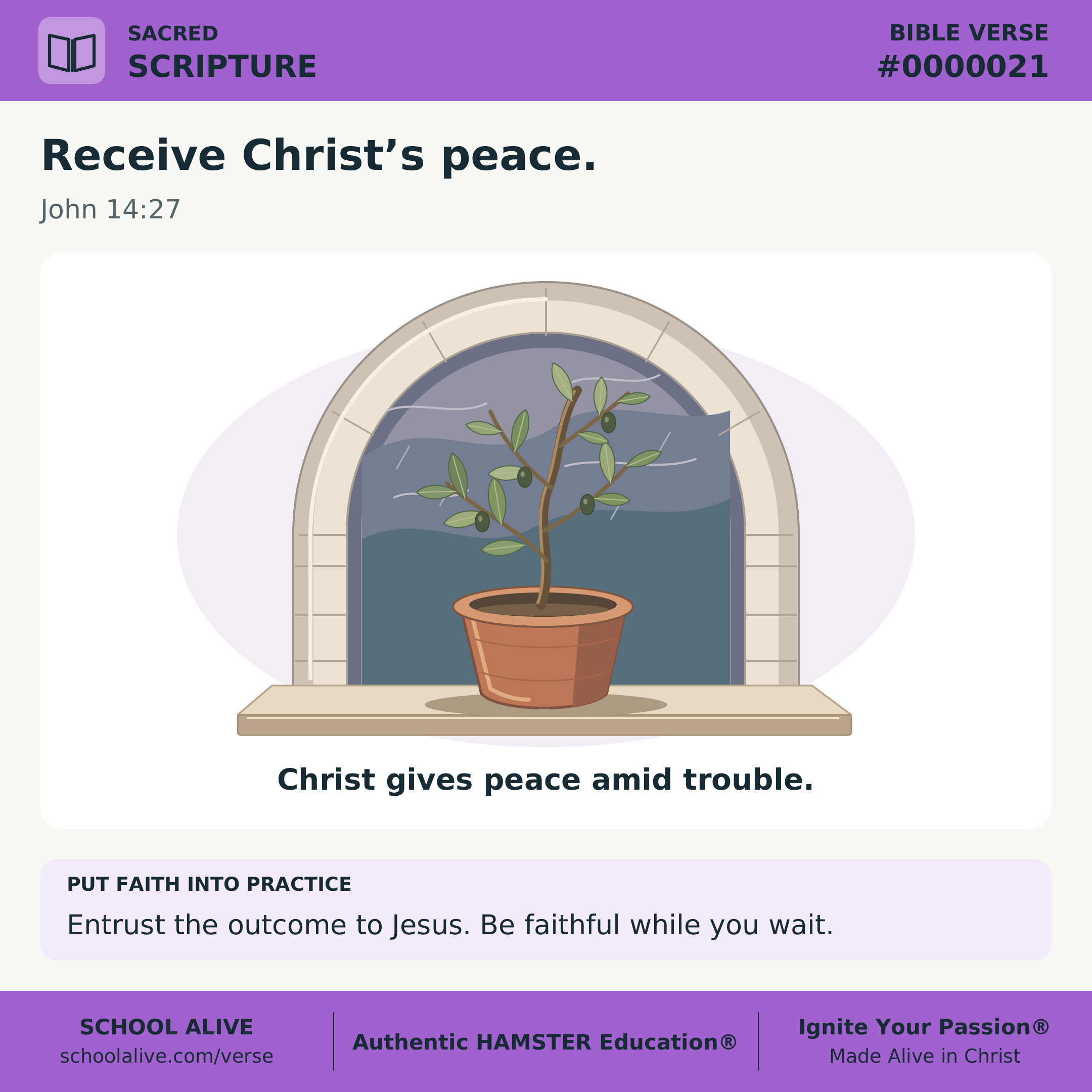
No. Jesus gives His own peace even amid trouble. Trust Him, bring your concerns to God, and live faithfully while you wait.
Scripture 1
“Peace I leave with you, my peace I give unto you: not as the world giveth, give I unto you. Let not your heart be troubled, neither let it be afraid” (John 14:27, KJV). Jesus gives His peace before the trouble ends.
Scripture 2
“These things I have spoken unto you, that in me ye might have peace. In the world ye shall have tribulation: but be of good cheer; I have overcome the world” (John 16:33, KJV). Peace in Christ remains possible amid trouble in the world.
Scripture 3
“Be careful for nothing; but in every thing by prayer and supplication with thanksgiving let your requests be made known unto God. And the peace of God, which passeth all understanding, shall keep your hearts and minds through Christ Jesus” (Philippians 4:6–7, KJV). Bring requests with thanksgiving; God guards your heart in Christ.
Prayer
Jesus, thank You for Your peace. Guard our hearts and help us trust You while we wait. Amen.
Challenge
Choose one unresolved matter you keep checking today. Pray, “Jesus, I entrust this outcome to You; help me receive Your peace while I wait.” Set the next genuinely useful time to check or follow up, then put unnecessary checking aside and give your attention to one present responsibility. Keep urgent needs available; peace means trusting Christ, not neglecting care.
 Must everything be settled before we can have peace?
 No. Jesus gives His own peace even amid trouble. Trust Him, bring your concerns to God, and live faithfully while you wait.
 “Peace I leave with you, my peace I give unto you: not as the world giveth, give I unto you. Let not your heart be troubled, neither let it be afraid” (
 Jesus, thank You for Your peace. Guard our hearts and help us trust You while we wait. Amen.
 Choose one unresolved matter you keep checking today. Pray, “Jesus, I entrust this outcome to You; help me receive Your peace while I wait.” Set the next genuinely useful time to check or follow up, then put unnecessary checking aside and give your attention to one present responsibility. Keep urgent needs available; peace means trusting Christ, not neglecting care.
Dive deeper
Context
New Testament · In John’s Gospel, Jesus speaks to His disciples on the night before His crucifixion. They are troubled by His coming departure. John 14 calls them to trust the Father and the Son, and promises the Holy Spirit, whom the Father will send in Jesus’ name. Verse 27 is part of this farewell teaching: Jesus gives His own peace before the disciples face the cross, separation, and uncertainty. The Gospel is written so readers may believe in Jesus the Messiah and have life in His name (20:30–31).
Read the surrounding passage →Meaning
Jesus does more than wish His friends a peaceful farewell. He gives them His own peace while a terrible night is approaching. His words do not deny the reality of loss, danger, or distress. In the surrounding passage, He promises the Father’s care and the Holy Spirit’s presence and teaching. Christian peace rests in the trustworthy Savior who goes to the cross and rises again, not in our power to control what happens next. We can receive His gift without pretending that an unsettled situation is already resolved.
John 16:33 prevents us from confusing this peace with a trouble-free life. Jesus tells the disciples that they will face trouble and still invites them to take courage in His victory. Philippians 4:6–7 gives a corresponding practice: bring particular requests to God with thanksgiving. Paul writes this encouragement while imprisoned. Prayer is not a bargain that obligates God to give the outcome we prefer, and anxiety is not cured by scolding ourselves. We can honestly name our concerns, remember God’s faithfulness, and seek His guarding care in Christ while continuing to use wise help.
Waiting often tempts us to seek certainty through repeated checking: refreshing a result page, rereading an unanswered message, or scanning the same news. Necessary updates and responsible action matter, but constant checking cannot supply the peace Jesus gives. One practical response is to bring a real concern to Him, decide when the next useful check or action is needed, and give attention to the responsibility or person before us. This is an application of His promise, not a command against technology or a reason to ignore urgent needs. Christ’s peace frees us to be faithful in the present while the future remains in His hands.
Original language · Koine Greek
Εἰρήνην ἀφίημι ὑμῖν, εἰρήνην τὴν ἐμὴν δίδωμι ὑμῖν· οὐ καθὼς ὁ κόσμος δίδωσιν, ἐγὼ δίδωμι ὑμῖν. Μὴ ταρασσέσθω ὑμῶν ἡ καρδία, μηδὲ δειλιάτω.This Greek edition belongs to the textual tradition used by the KJV. Other translations may follow a different Greek edition. Text: AO Lab · Edition & rights
The supplied original text is the Textus Receptus. Jesus speaks these words to His disciples in His farewell teaching before the cross.
- Εἰρήνην (eirēnēn) · peace Strong’s G1515 · dictionary entry, opens another tab
- This form of eirēnē names the peace Jesus gives. Thayer connects John 14:27 with a farewell blessing, emphasizing that Christ gives peace rather than merely wishing it. The surrounding passage establishes its character; the word alone does not promise favorable circumstances.
- δειλιάτω (deiliatō) · be fearful / lose courage Strong’s G1168 · dictionary entry, opens another tab
- This form of deiliaō describes being fearful or timid. Jesus tells His disciples not to let their heart become fearful, grounding courage in His gift of peace. The command is an invitation to trust Him, not a diagnosis of every experience of anxiety.
Jesus gives His own peace amid coming trouble. Receive His gift and bring your concerns to God while continuing to act responsibly.
Language sources: Thayer / Strong’s G1515: eirēnē · Thayer / Strong’s G1168: deiliaō
Discuss together
What is the difference between a necessary follow-up and repeated checking that seeks certainty? How can we receive Christ’s peace without neglecting responsibilities or dismissing another person’s distress?
Ignite Your Passion®
Made Alive in Christ
Reflection prepared by School Alive.
Scripture quotations marked (KJV) are from the King James Version (1769). Public-domain text supplied by CrossWire Bible Society and eBible.org. Copyright & permissions