
Lesson
Care for your teeth.
HCaring HealthcareUnderstand how plaque affects teeth and put a consistent brushing routine into practice.
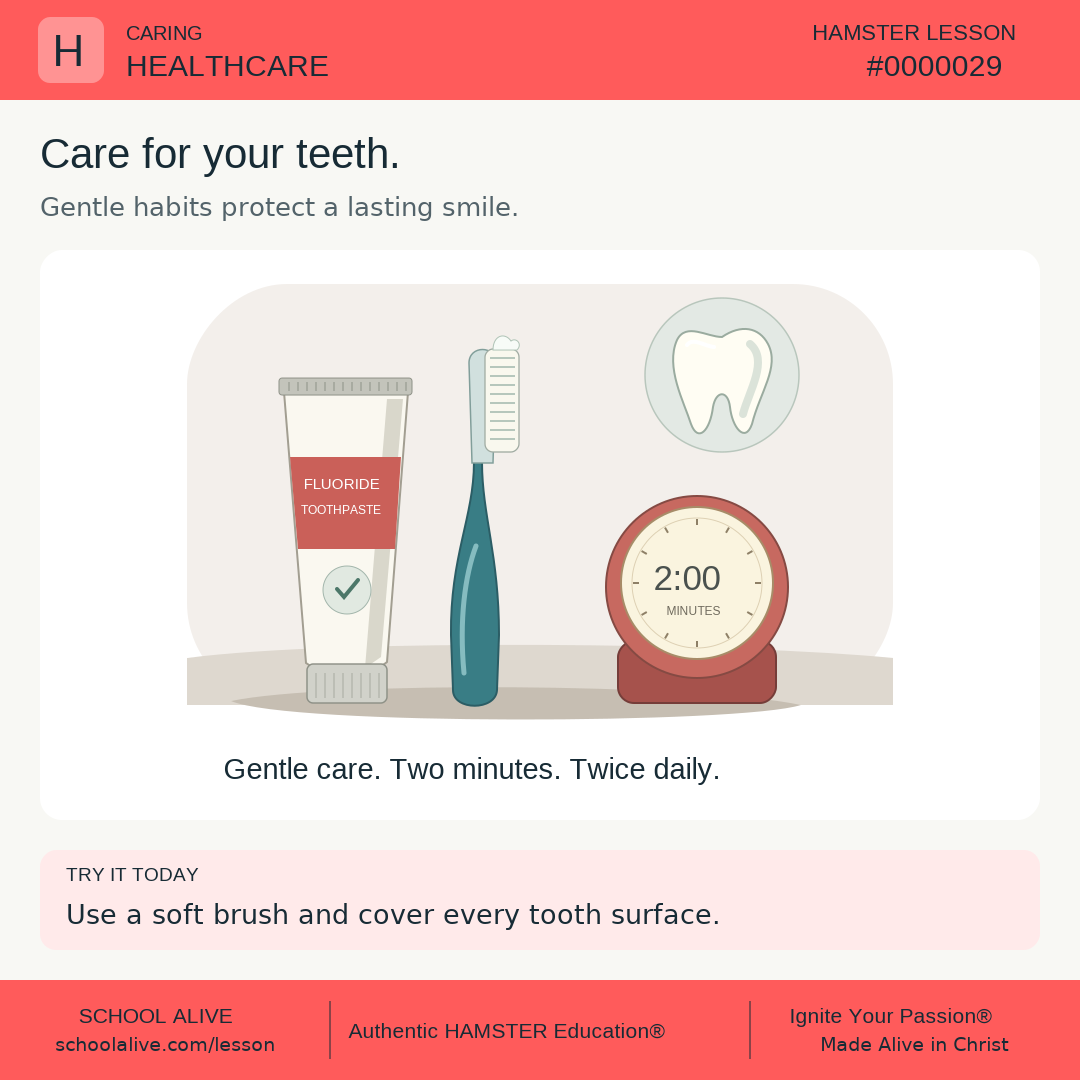
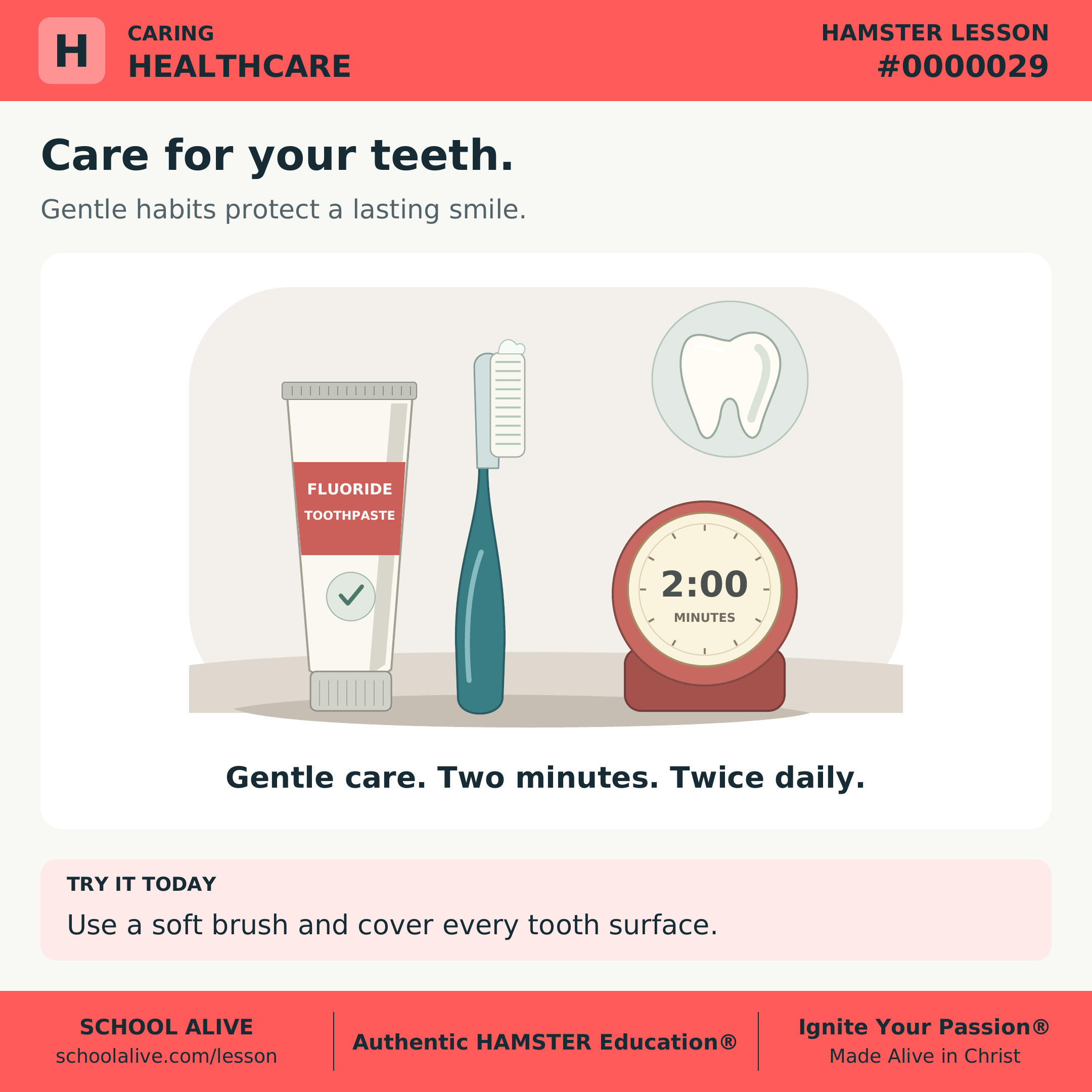
Plaque is a sticky film containing bacteria. Regular gentle brushing and fluoride toothpaste help protect teeth; more pressure is not the goal.
Question
Why do teeth need care even when they look clean?
 Why do teeth need care even when they look clean?
Answer
Plaque is a sticky film containing bacteria. Some bacteria use sugars to make acids that attack tooth enamel. Gentle brushing removes plaque, and fluoride toothpaste helps protect enamel.
 Plaque is a sticky film containing bacteria. Some bacteria use sugars to make acids that attack tooth enamel. Gentle brushing removes plaque, and fluoride toothpaste helps protect enamel.
History
Dental care has moved beyond repairing obvious damage toward preventing it. Research on plaque, enamel, and fluoride helps explain why small daily habits matter before a cavity appears.
 Dental care has moved beyond repairing obvious damage toward preventing it. Research on plaque, enamel, and fluoride helps explain why small daily habits matter before a cavity appears.
Example
A quick scrub may miss the inside surfaces and back teeth. A two-minute timer gives you time to brush the outside, inside, and chewing surfaces gently.
 A quick scrub may miss the inside surfaces and back teeth. A two-minute timer gives you time to brush the outside, inside, and chewing surfaces gently.
Insight
Harder does not mean cleaner. Use a soft-bristled brush and gentle strokes. The aim is to remove plaque while caring for teeth and gums, not to scour them.
 Harder does not mean cleaner. Use a soft-bristled brush and gentle strokes. The aim is to remove plaque while caring for teeth and gums, not to scour them.
Connection
This is prevention in practice: a repeated habit protects something valuable before a problem demands attention. Caring for the body God has given us includes ordinary routines.
 This is prevention in practice: a repeated habit protects something valuable before a problem demands attention. Caring for the body God has given us includes ordinary routines.
Challenge
At your next brushing, set a two-minute timer. Brush gently with fluoride toothpaste, covering the outside, inside, and chewing surfaces; spit out the toothpaste. Make this part of brushing twice each day. Help younger children use the appropriate amount and brush thoroughly.
 At your next brushing, set a two-minute timer. Brush gently with fluoride toothpaste, covering the outside, inside, and chewing surfaces; spit out the toothpaste. Make this part of brushing twice each day. Help younger children use the appropriate amount and brush thoroughly.
Dive deeper
Context
Healthcare includes preventing disease and preserving well-being. Teeth help us eat and speak, and their outer enamel faces repeated exposure to acids. Daily care supports oral health alongside regular dental visits and advice suited to the individual.
Understand the idea
The mouth contains many kinds of bacteria, and not all are harmful. Some bacteria in plaque use sugars and starches from food to produce acids. These acids can remove minerals from enamel. Saliva supplies minerals that help replace what is lost. Frequent acid exposure can tip that balance toward decay; an established cavity is damage that requires dental treatment.
Brushing disrupts plaque, while fluoride helps enamel resist mineral loss and supports repair of early damage. A soft brush and gentle technique are important. Brush the outer, inner, and chewing surfaces rather than repeatedly scrubbing only the visible front teeth. Cleaning between teeth daily reaches places a brush does not readily reach; a dentist can recommend suitable tools.
Consistency matters more than an occasional burst of effort. The ADA recommends brushing twice daily for two minutes with fluoride toothpaste. For children aged three to six, use a pea-sized amount and supervise brushing and spitting; younger children need a rice-grain-sized smear. Follow individual dental advice. A simple timer can support the habit, but it cannot replace technique or a dental assessment when something hurts.
Plan a complete two-minute routine
- On paper, draw four simple boxes for the upper right, upper left, lower right, and lower left parts of the mouth.
- Plan to spend about thirty seconds on each area, including its outer, inner, and chewing surfaces.
- At your next normal brushing, try the timer and gentle technique. Do not add extra force to beat the clock.
- Afterward, name one area you tend to miss and adjust your next routine. This is a habit check, not a test for cavities.
Discuss together
- Why might a routine fail even if someone owns all the right tools?
- How can a family make daily care easier without turning it into criticism?
Introducing Microlessons
One idea. Seven steps. A practical discovery.
Begin with a question and a clear answer. Explore the history, an example, and a deeper insight. Connect the idea to everyday life, then put it into practice.
Read on your own or talk it through together. Each prepared edition includes a shareable image, concise text, and a one-page PDF.
How the 7 steps work
Each lesson moves from curiosity to understanding to practical action. Here is what each step contributes.
Question
Opens a question worth exploring and gives the lesson a clear purpose.
Answer
Gives a clear starting point that the rest of the lesson helps us understand.
History
Shows how people encountered the idea and how their discoveries shaped what we know.
Example
Makes the idea concrete through a situation, demonstration, or worked example.
Insight
Draws out the deeper principle so we understand why the idea matters.
Connection
Connects the idea to other disciplines, our faith, and everyday life.
Challenge
Turns understanding into action through something to try, practice, or explain.