
Lesson
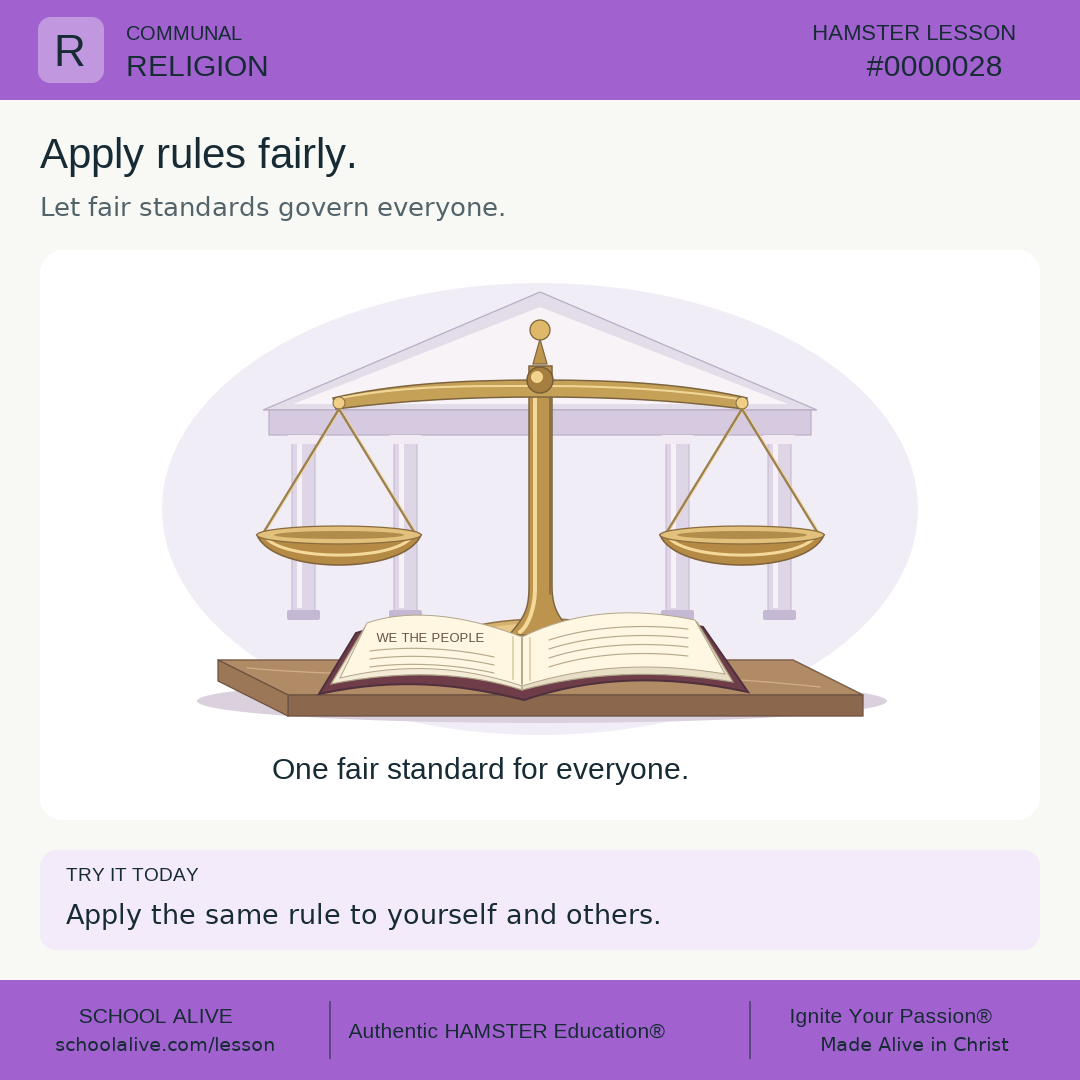
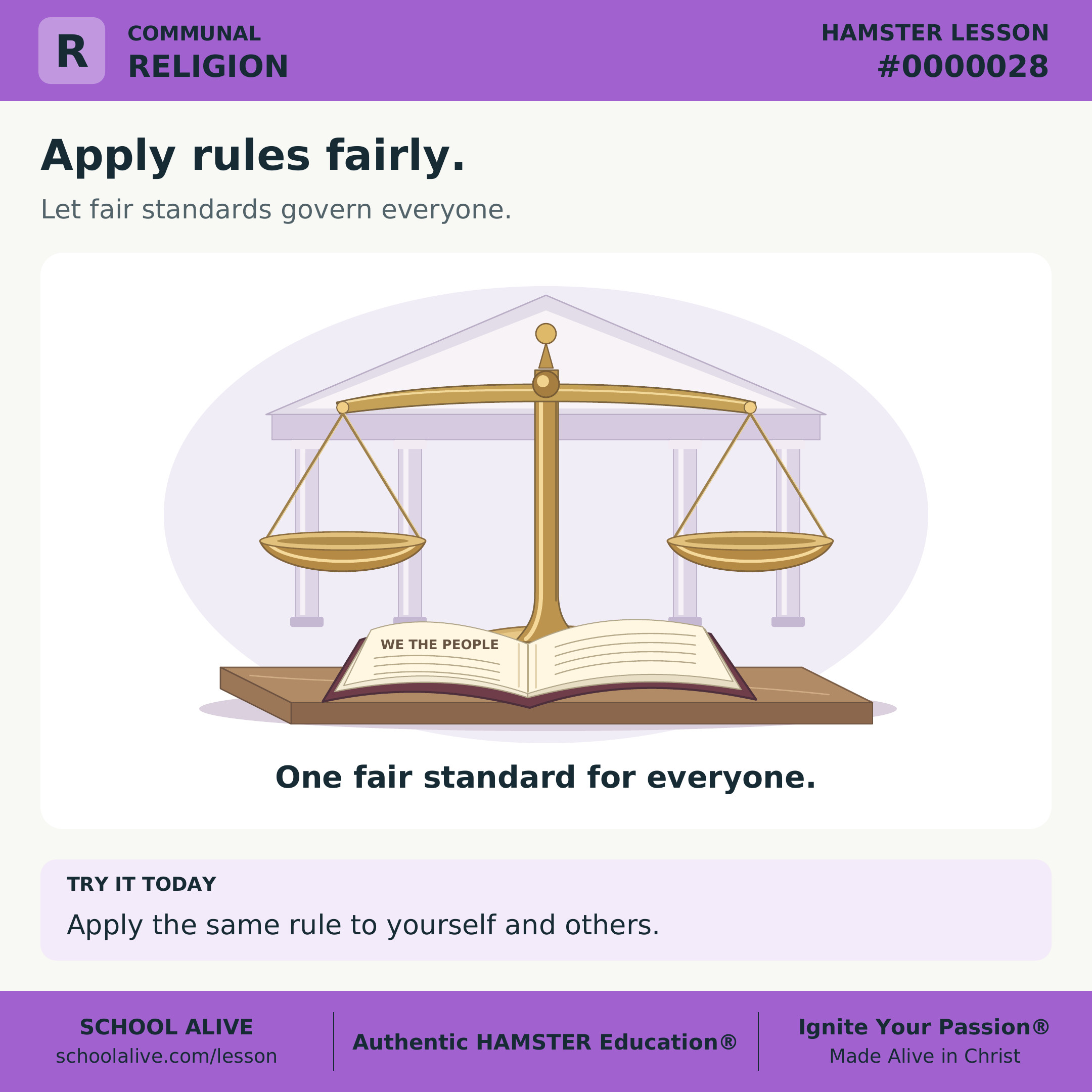
Apply rules fairly.
RCommunal ReligionDistinguish fair application of a shared rule from favoritism, including when a leader is involved.
Civics and worldview · Rule of law, responsibility, and impartial treatment.
Question
Should a rule change because the person affected is popular or powerful?
 Should a rule change because the person affected is popular or powerful?
Answer
The rule of law means publicly known laws govern people and leaders through fair procedures. Authority does not place someone above the law.
 The rule of law means publicly known laws govern people and leaders through fair procedures. Authority does not place someone above the law.
History
The U.S. Constitution was signed in 1787. Article VI requires federal and state lawmakers, executive officers, and judges to support the Constitution by oath or affirmation, placing a duty on those who exercise authority.
 The U.S. Constitution was signed in 1787. Article VI requires federal and state lawmakers, executive officers, and judges to support the Constitution by oath or affirmation, placing a duty on those who exercise authority.
Example
A group agrees to lend shared equipment in signup order. The organizer’s friend asks to move ahead. Applying the agreed order to the friend as well as everyone else shows impartiality.
 A group agrees to lend shared equipment in signup order. The organizer’s friend asks to move ahead. Applying the agreed order to the friend as well as everyone else shows impartiality.
Insight
Fairness includes hearing relevant facts. A clearly justified exception can serve a real need; a special favor simply rewards a preferred person. A written rule also needs a just purpose and a fair way to question it.
 Fairness includes hearing relevant facts. A clearly justified exception can serve a real need; a special favor simply rewards a preferred person. A written rule also needs a just purpose and a fair way to question it.
Connection
A community’s rules reveal what it believes about people, authority, and justice. These are questions of worldview as well as civics. Respect for our God-given dignity calls us to treat others with integrity, even when favoritism would benefit us.
 A community’s rules reveal what it believes about people, authority, and justice. These are questions of worldview as well as civics. Respect for our God-given dignity calls us to treat others with integrity, even when favoritism would benefit us.
Challenge
Today, honor one fair shared rule even when it costs you a convenience: wait your turn, keep the agreed time limit, or follow the same signup order as everyone else. Say, “The same rule should apply to me.”
 Today, honor one fair shared rule even when it costs you a convenience: wait your turn, keep the agreed time limit, or follow the same signup order as everyone else. Say, “The same rule should apply to me.”
Dive deeper
Context
Rules shape how people live together. They can protect trustworthy cooperation, or they can become excuses for favoritism. Studying civics within Religion asks what a community regards as right, what limits authority should have, and how people should answer for their actions.
Understand the idea
The rule of law puts public standards above a person’s wishes. The Sixth Circuit’s civics materials explain that laws apply to lawmakers, enforcement officers, and judges as well as the people they serve. Fair procedures matter: an accusation is not the same as a proven fact, and disputes need an impartial way to be heard. A leader’s popularity cannot substitute for a reasoned decision.
The Constitution’s Article VI connects lawful authority with constitutional limits. Its oath requirement binds officials to support the Constitution rather than merely please a powerful person. Stating an ideal does not guarantee that a society always meets it. Citizens and officials must examine actions against that standard, admit failures, and use legitimate review and reform to address injustice.
In everyday life, practice by separating a relevant difference from a personal preference. A damaged tool may need to be taken out of circulation for everyone’s safety; that is different from skipping the signup list for a friend. Explain the reason, listen to the affected people, and apply the same reasoning in comparable cases. If a rule causes an unfair result, question and improve it openly instead of secretly making yourself an exception.
Test the rule with the names changed
- Choose a simple shared rule, such as equal speaking time in a discussion or signup order for equipment. State its purpose in one sentence.
- Imagine that a close friend wants an exception. Then replace the friend with someone you barely know. Would your decision change even though the relevant facts stayed the same?
- Consider a real difference: the equipment is damaged, or someone has an urgent need. Explain whether the rule allows a reasonable response and who should review it. Do not treat every different circumstance as favoritism.
- Apply the fair standard to yourself today. If the rule is unclear or unfair, propose a clearer version openly before the next decision. Include how a person can raise a concern and be heard.
Discuss together
- How does expecting leaders to follow the law protect a community?
- What distinguishes a justified exception from a special favor?
Introducing Microlessons
One idea. Seven steps. A practical discovery.
Begin with a question and a clear answer. Explore the history, an example, and a deeper insight. Connect the idea to everyday life, then put it into practice.
Read on your own or talk it through together. Each prepared edition includes a shareable image, concise text, and a one-page PDF.
How the 7 steps work
Each lesson moves from curiosity to understanding to practical action. Here is what each step contributes.
Question
Opens a question worth exploring and gives the lesson a clear purpose.
Answer
Gives a clear starting point that the rest of the lesson helps us understand.
History
Shows how people encountered the idea and how their discoveries shaped what we know.
Example
Makes the idea concrete through a situation, demonstration, or worked example.
Insight
Draws out the deeper principle so we understand why the idea matters.
Connection
Connects the idea to other disciplines, our faith, and everyday life.
Challenge
Turns understanding into action through something to try, practice, or explain.