
Lesson
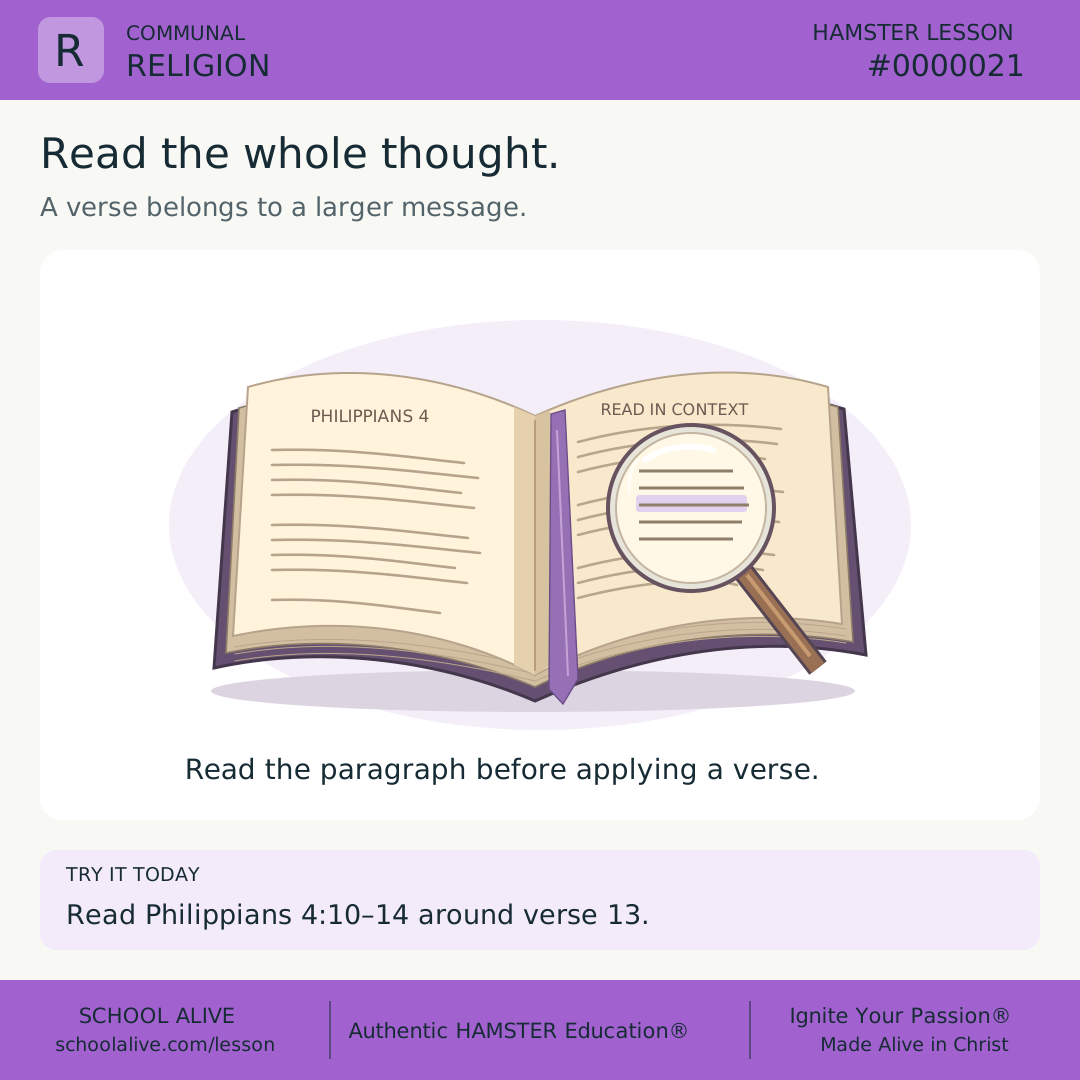
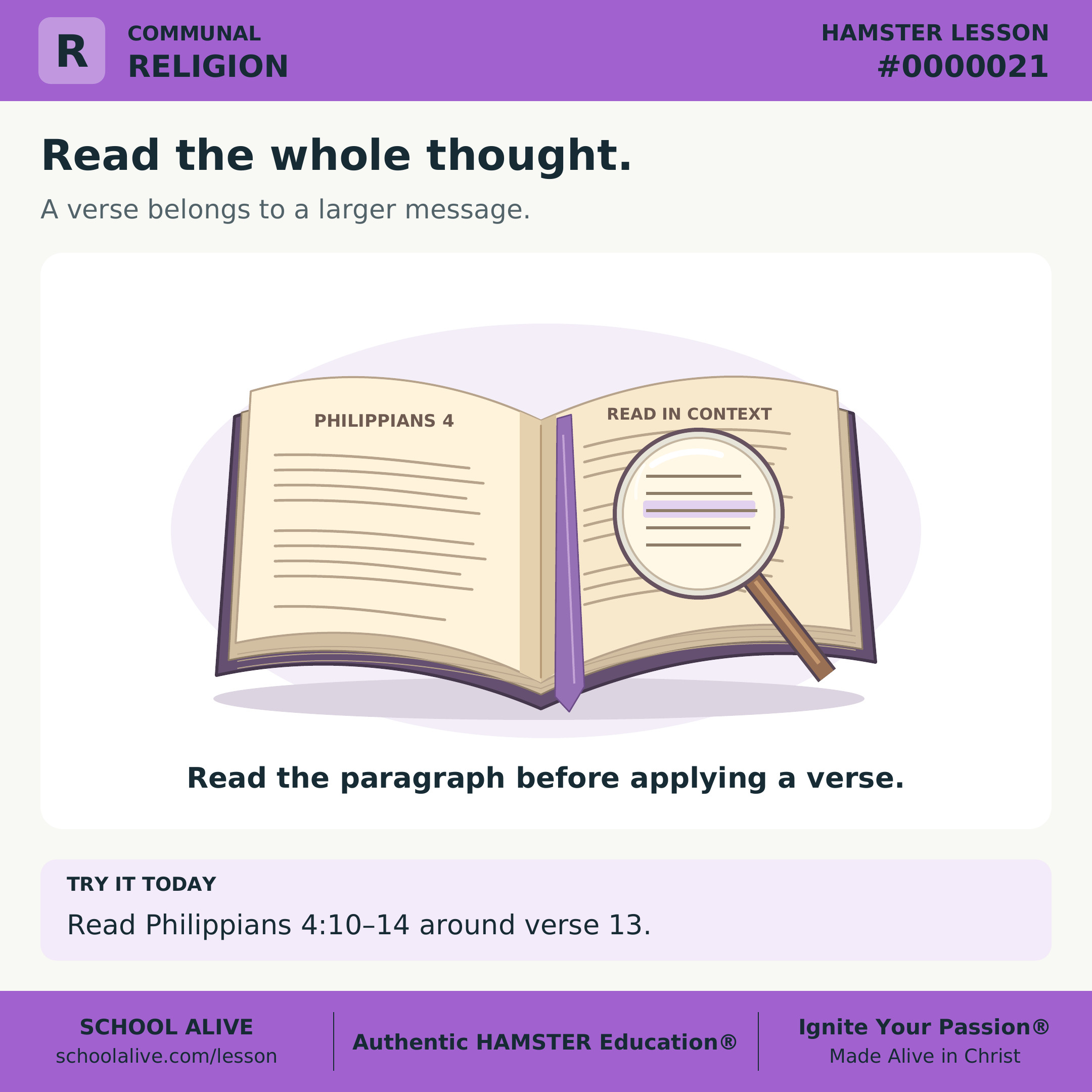
Read the whole thought.
RCommunal ReligionInterpret a verse in its surrounding passage before applying it.
Biblical understanding · Context guides faithful application.
Question
Can a familiar Bible verse mean something different when we read the sentences around it?
 Can a familiar Bible verse mean something different when we read the sentences around it?
Answer
The surrounding passage helps us recognize the author’s meaning. Before applying one line, ask who is speaking, to whom, and how that line fits the whole thought.
 The surrounding passage helps us recognize the author’s meaning. Before applying one line, ask who is speaking, to whom, and how that line fits the whole thought.
History
Paul wrote Philippians to believers at Philippi while imprisoned. The letter expresses affection for their partnership in the gospel; its closing section thanks them for practical support.
 Paul wrote Philippians to believers at Philippi while imprisoned. The letter expresses affection for their partnership in the gospel; its closing section thanks them for practical support.
Example
Philippians 4:13 follows Paul’s description of contentment in hunger and plenty. Read 4:10–14: his strength concerns faithfulness in changing circumstances, not a guarantee of winning every competition.
 Philippians 4:13 follows Paul’s description of contentment in hunger and plenty. Read 4:10–14: his strength concerns faithfulness in changing circumstances, not a guarantee of winning every competition.
Insight
A familiar phrase can become a slogan detached from its purpose. Context does not weaken Scripture’s encouragement; it helps us receive the encouragement the passage actually gives.
 A familiar phrase can become a slogan detached from its purpose. Context does not weaken Scripture’s encouragement; it helps us receive the encouragement the passage actually gives.
Connection
Careful reading also matters in a message from a friend or a workplace instruction. In Bible study, listening before applying honors God’s Word instead of making it serve our preferred conclusion.
 Careful reading also matters in a message from a friend or a workplace instruction. In Bible study, listening before applying honors God’s Word instead of making it serve our preferred conclusion.
Challenge
Before using a verse to encourage someone today, read its surrounding paragraph. Check whether your message fits it. For Philippians 4:13, offer encouragement to depend on Christ in difficulty rather than promise a particular result.
 Before using a verse to encourage someone today, read its surrounding paragraph. Check whether your message fits it. For Philippians 4:13, offer encouragement to depend on Christ in difficulty rather than promise a particular result.
Dive deeper
Context
Philippians is a New Testament letter, not a collection of unrelated sayings. Its opening names Paul and Timothy and addresses the believers at Philippi. Paul discusses his imprisonment in chapter 1. Reading the opening and the closing together helps us hear a real communication between people who share in the gospel.
Understand the idea
Begin with observation. Read a complete paragraph and notice the subject, repeated words, contrasts, and connecting words. Ask what question the author is addressing. A verse number is useful for finding a line, but it does not make that line independent of the sentences beside it. Read farther if a pronoun or connecting word points beyond the paragraph.
In Philippians 4:10–14, Paul describes both scarcity and abundance and expresses gratitude for support. His confidence is compatible with difficulty. Applying his statement as a guarantee of wealth or a particular achievement would replace the stated situation with a different promise. Dependence on Christ and contentment fit the passage’s direction.
Move from meaning to response. Separate what you can point to in the text from what you infer and what you personally plan to do. Another reader should be able to follow your explanation back to the passage. If you are uncertain, keep the question open and seek help from a careful teacher. In Acts 17:10–12, the Bereans receive the message eagerly and examine Scripture; attentiveness and honest checking belong together.
Check an encouragement before sharing it
- Read Philippians 1:1–14 and identify the recipients and Paul’s situation. Then read 4:10–14 without stopping at verse 13.
- On a page, make three headings: Observation, Meaning, Response. Under Observation, note the contrasting circumstances in 4:12. Under Meaning, explain how those circumstances shape the next verse.
- Compare these possible messages: “You will definitely get the result you want” and “You can depend on Christ while facing this difficulty.” Explain which fits the passage and which adds a promise it does not make.
- Choose a real person you want to encourage. Offer a brief, truthful message consistent with the passage, and include practical care if useful. Do not imply that continuing hardship proves a lack of faith.
Discuss together
- What is lost when a line about strength is separated from Paul’s experience of need?
- How can we welcome correction about a verse we have quoted for years?
Introducing Microlessons
One idea. Seven steps. A practical discovery.
Begin with a question and a clear answer. Explore the history, an example, and a deeper insight. Connect the idea to everyday life, then put it into practice.
Read on your own or talk it through together. Each prepared edition includes a shareable image, concise text, and a one-page PDF.
How the 7 steps work
Each lesson moves from curiosity to understanding to practical action. Here is what each step contributes.
Question
Opens a question worth exploring and gives the lesson a clear purpose.
Answer
Gives a clear starting point that the rest of the lesson helps us understand.
History
Shows how people encountered the idea and how their discoveries shaped what we know.
Example
Makes the idea concrete through a situation, demonstration, or worked example.
Insight
Draws out the deeper principle so we understand why the idea matters.
Connection
Connects the idea to other disciplines, our faith, and everyday life.
Challenge
Turns understanding into action through something to try, practice, or explain.