
Lesson
Balance the lever.
ECreative EngineeringPredict and test how distance from a pivot affects balance.
Mechanical engineering · Weight, distance, and turning effect.
Question
Can one weight balance two identical weights on the other side of a lever?
 Can one weight balance two identical weights on the other side of a lever?
Answer
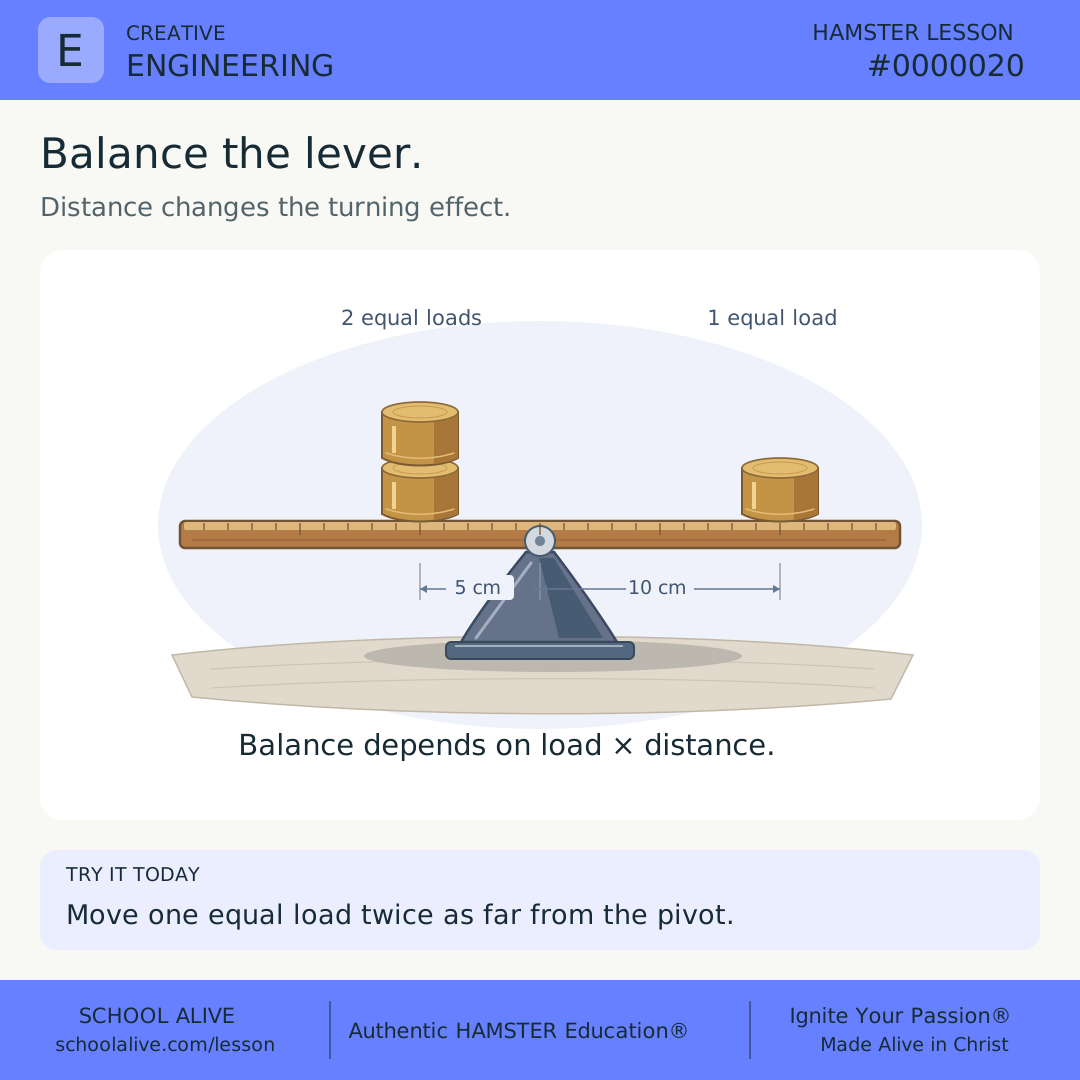
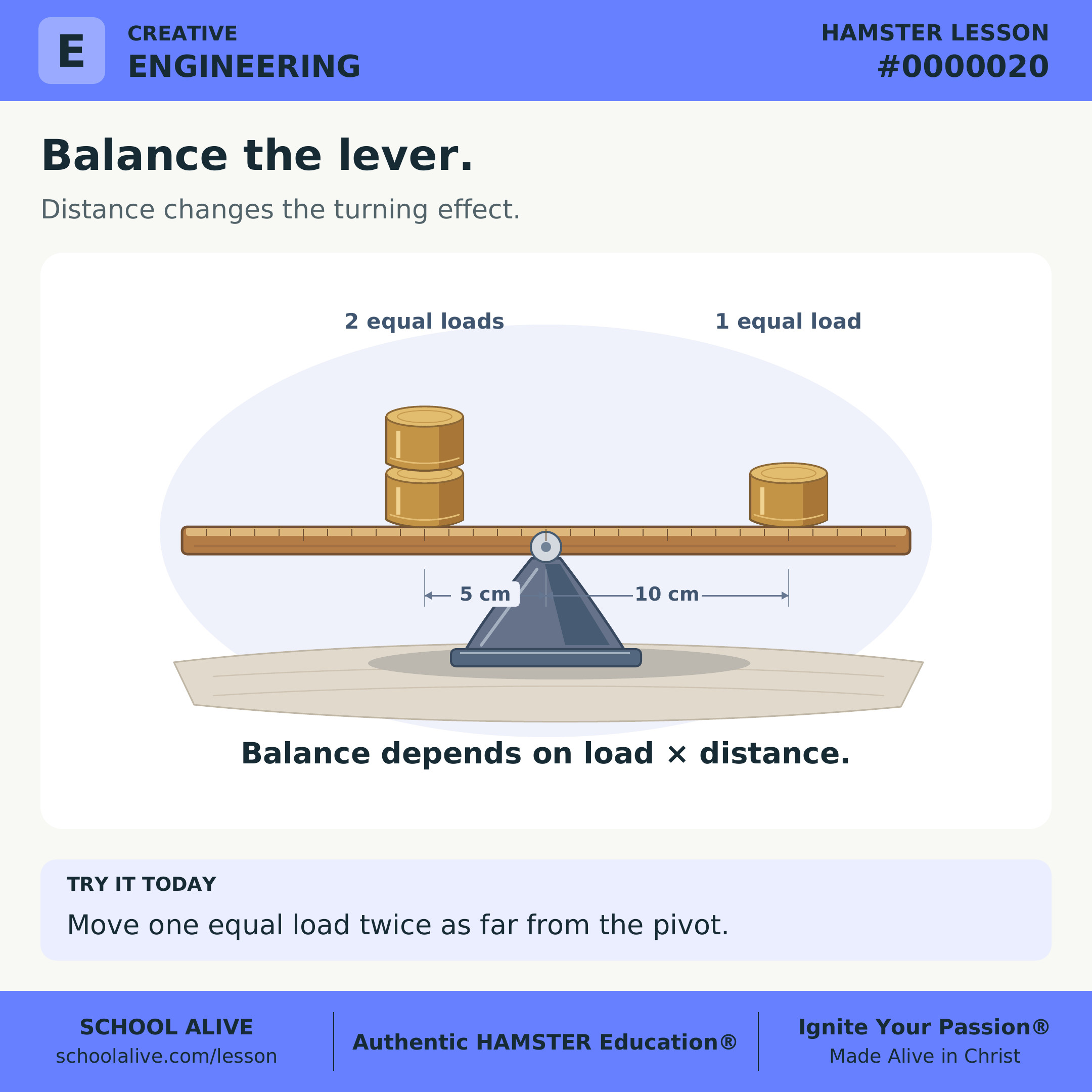
Yes, if the single weight is twice as far from the pivot. Balance depends on both weight and distance from the pivot, not just the number of objects.
 Yes, if the single weight is twice as far from the pivot. Balance depends on both weight and distance from the pivot, not just the number of objects.
History
The Science Museum Group holds an Egyptian equal-arm balance from about 1370–1350 BC. Its two pans compared an object with known weights, showing how useful a balanced beam has been for thousands of years.
 The Science Museum Group holds an Egyptian equal-arm balance from about 1370–1350 BC. Its two pans compared an object with known weights, showing how useful a balanced beam has been for thousands of years.
Example
Balance an empty ruler on a support. Put two identical coins 5 cm to one side of the pivot and one matching coin 10 cm to the other. Their turning effects should nearly balance.
 Balance an empty ruler on a support. Put two identical coins 5 cm to one side of the pivot and one matching coin 10 cm to the other. Their turning effects should nearly balance.
Insight
The same force has a greater turning effect farther from a pivot. A longer lever arm can reduce the force needed, but its end must travel farther: a lever does not create energy.
 The same force has a greater turning effect farther from a pivot. A longer lever arm can reduce the force needed, but its end must travel farther: a lever does not create energy.
Connection
From pliers to a wheelbarrow, engineers arrange pivots, loads, and handles to help people accomplish tasks. Understanding the arrangement helps us choose a suitable tool instead of simply pushing harder.
 From pliers to a wheelbarrow, engineers arrange pivots, loads, and handles to help people accomplish tasks. Understanding the arrangement helps us choose a suitable tool instead of simply pushing harder.
Challenge
Today, balance a ruler with two identical coins 5 cm from its pivot and one matching coin on the other side. Predict where the single coin should go, test your prediction, and measure the distance that brings the ruler close to level.
 Today, balance a ruler with two identical coins 5 cm from its pivot and one matching coin on the other side. Predict where the single coin should go, test your prediction, and measure the distance that brings the ruler close to level.
Dive deeper
Context
A lever is a rigid beam that turns around a support called a fulcrum. Our tabletop model explores a design question: how can placement change what a tool can do? Keep the loads small and the beam close to the table.
Understand the idea
For a horizontal beam with downward loads, each turning effect equals the force multiplied by its horizontal distance from the pivot. Engineers call this turning effect torque. Opposite turning effects balance when their products match. With identical coins, two coins at 5 cm and one at 10 cm give the same product: 2 × 5 = 1 × 10.
Balance the empty ruler first so its own weight does not favor one side. Measure from the actual pivot to the center of each coin or stack, rather than from an end of the ruler. A broad support, friction, uneven coins, and a bending ruler can affect the result. A close result supports the model; a mismatch is a reason to inspect the setup and repeat.
When a lever moves through an angle, a point farther from the pivot travels a longer path. That is the tradeoff behind gaining force: a smaller input force acts through a greater distance. Real tools also have friction, limited travel, and material limits. A tabletop balance explains one principle; it is not a lifting plan for heavy objects.
Measure a balanced tradeoff
- Use a stiff 30 cm ruler, a pencil, three matching coins, and a flat table. Secure the pencil against rolling without taping the ruler to it. Rest the ruler across it and find the position where the empty ruler balances.
- Keep the pivot fixed. Stack two coins with their centers 5 cm to one side. Predict where one matching coin belongs on the other side, then test. Measure all distances from the pivot, moving the coin gently without launching it.
- Record the actual balance distance. Move the two-coin stack to 4 cm and predict the new single-coin distance before testing. Compare both trials with the weight-times-distance rule; check that the ruler and pivot did not shift.
- Observe a pair of pliers or a wheelbarrow without lifting a load. Identify the pivot, the load location, and where a person applies force. Explain which distances its designer can change and what movement space the tool needs.
Discuss together
- Why can unequal numbers of identical coins balance at unequal distances?
- What would you inspect if the ruler did not balance near your predicted position?
Introducing Microlessons
One idea. Seven steps. A practical discovery.
Begin with a question and a clear answer. Explore the history, an example, and a deeper insight. Connect the idea to everyday life, then put it into practice.
Read on your own or talk it through together. Each prepared edition includes a shareable image, concise text, and a one-page PDF.
How the 7 steps work
Each lesson moves from curiosity to understanding to practical action. Here is what each step contributes.
Question
Opens a question worth exploring and gives the lesson a clear purpose.
Answer
Gives a clear starting point that the rest of the lesson helps us understand.
History
Shows how people encountered the idea and how their discoveries shaped what we know.
Example
Makes the idea concrete through a situation, demonstration, or worked example.
Insight
Draws out the deeper principle so we understand why the idea matters.
Connection
Connects the idea to other disciplines, our faith, and everyday life.
Challenge
Turns understanding into action through something to try, practice, or explain.