
Lesson
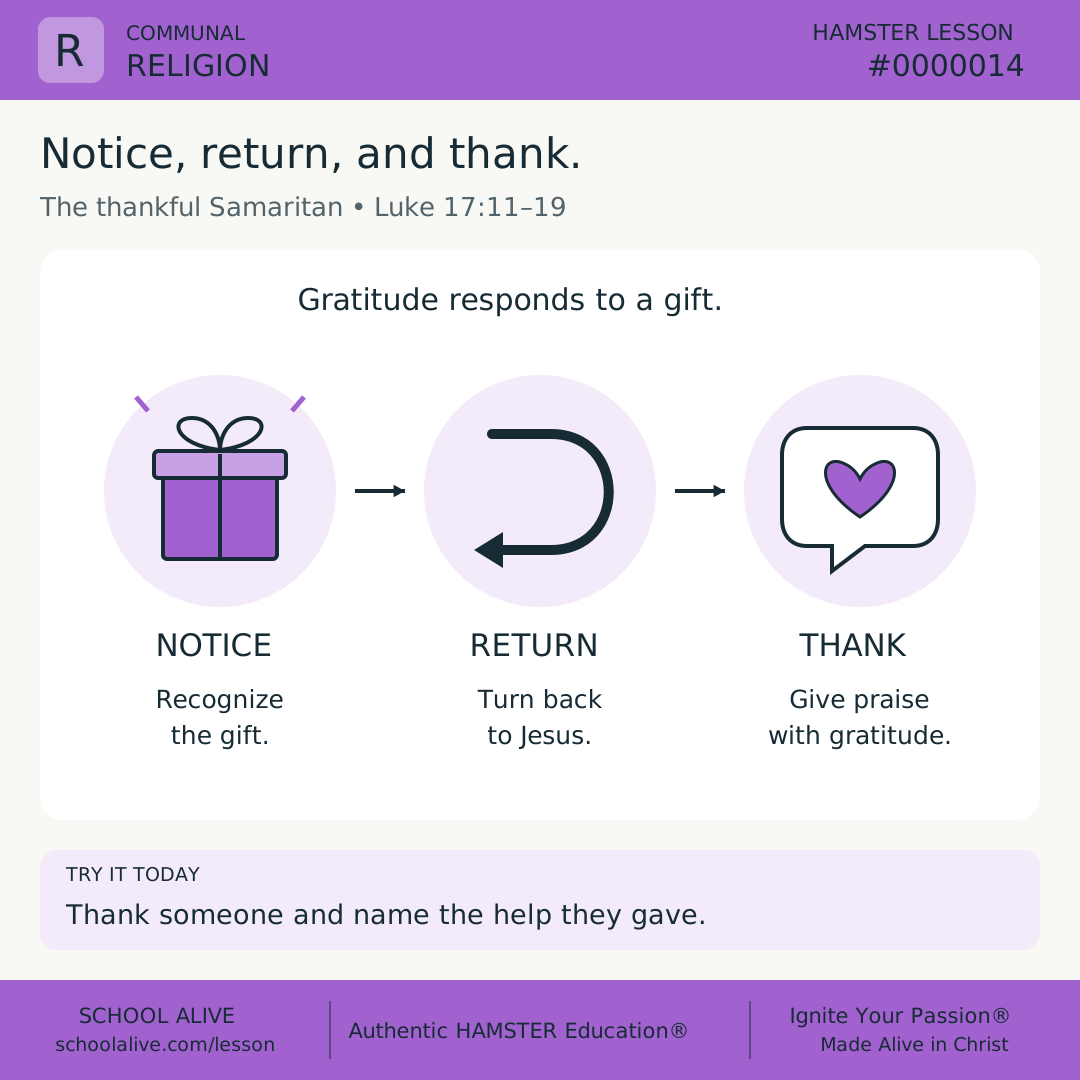
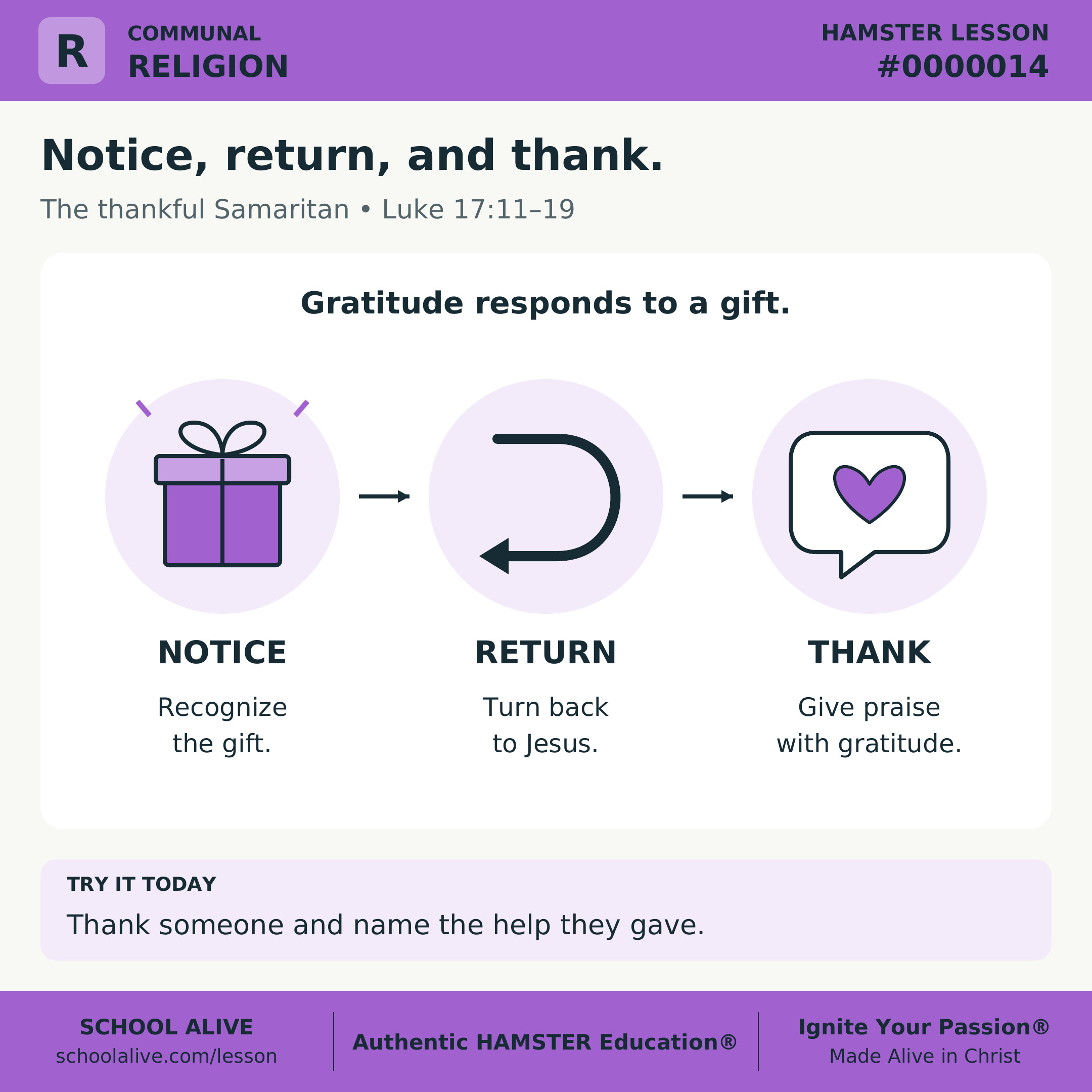
Notice, return, and thank.
RCommunal ReligionRecognize gratitude in a Gospel account and practice specific thanks.
Biblical understanding · Gratitude as a response to Jesus’ mercy.
Question
How can we respond when someone shows us kindness?
 How can we respond when someone shows us kindness?
Answer
Notice the gift and thank the giver. Luke tells how one man returned to praise God and thank Jesus after being healed.
 Notice the gift and thank the giver. Luke tells how one man returned to praise God and thank Jesus after being healed.
History
Luke 17:11–19 is a Gospel account from Jesus’ journey toward Jerusalem. Ten men with a skin disease ask Him for mercy; one who returns is a Samaritan.
 Luke 17:11–19 is a Gospel account from Jesus’ journey toward Jerusalem. Ten men with a skin disease ask Him for mercy; one who returns is a Samaritan.
Example
All ten are cleansed as they go to show themselves to the priests. One turns back, praises God, and falls at Jesus’ feet in gratitude.
 All ten are cleansed as they go to show themselves to the priests. One turns back, praises God, and falls at Jesus’ feet in gratitude.
Insight
The returning man pays attention to the giver, not only the gift. His gratitude responds to mercy already received; it does not buy healing.
 The returning man pays attention to the giver, not only the gift. His gratitude responds to mercy already received; it does not buy healing.
Connection
We can thank God in prayer and thank people for their care. Being grateful does not require hiding sadness or pretending every difficulty has ended.
 We can thank God in prayer and thank people for their care. Being grateful does not require hiding sadness or pretending every difficulty has ended.
Challenge
Today, thank one person for a specific kindness: “Thank you for taking time to help me with ___.” Tell them how it helped, then thank God for that care.
 Today, thank one person for a specific kindness: “Thank you for taking time to help me with ___.” Tell them how it helped, then thank God for that care.
Dive deeper
Context
Luke records Jesus traveling between Samaria and Galilee on His way to Jerusalem. Ten men stand at a distance and ask for mercy. Jesus tells them to show themselves to the priests, and they are cleansed as they go. This is an account of an encounter, rather than a parable.
Understand the idea
Notice the sequence: the men ask, Jesus responds, they go, and they are cleansed. The man’s thanks comes after the gift. We should not treat gratitude as a method for making God provide a desired outcome.
Luke identifies the returning man as a Samaritan, and Jesus calls him a foreigner. His response challenges an assumption that only familiar insiders can model faith. Describe his actions rather than stereotyping any whole group.
The man praises God and thanks Jesus. Christians can practice both prayerful thanksgiving and personal appreciation. Specific thanks names what was done; it is more meaningful than using praise to get another favor.
From noticing to thanking
- Read Luke 17:11–19 together. Find what happens before the man returns and what he does afterward.
- Name someone who helped you recently. Complete: “You helped me by ___. That mattered because ___.”
- Tell the person your thanks without asking for a favor. Pray together, thanking God and also bringing Him any difficulties you still face.
Discuss together
- Why does the order of healing and thanks matter?
- How can someone be sincerely thankful and still feel sad about a difficult situation?
Introducing Microlessons
One idea. Seven steps. A practical discovery.
Begin with a question and a clear answer. Explore the history, an example, and a deeper insight. Connect the idea to everyday life, then put it into practice.
Read on your own or talk it through together. Each prepared edition includes a shareable image, concise text, and a one-page PDF.
How the 7 steps work
Each lesson moves from curiosity to understanding to practical action. Here is what each step contributes.
Question
Opens a question worth exploring and gives the lesson a clear purpose.
Answer
Gives a clear starting point that the rest of the lesson helps us understand.
History
Shows how people encountered the idea and how their discoveries shaped what we know.
Example
Makes the idea concrete through a situation, demonstration, or worked example.
Insight
Draws out the deeper principle so we understand why the idea matters.
Connection
Connects the idea to other disciplines, our faith, and everyday life.
Challenge
Turns understanding into action through something to try, practice, or explain.