
Lesson
Change one thing.
SCurious SciencePlan a fair comparison by changing one factor and recording repeated trials.
Fair tests · Change one factor, keep others consistent.
Question
How can we test whether a surface changes how far a toy car rolls?
 How can we test whether a surface changes how far a toy car rolls?
Answer
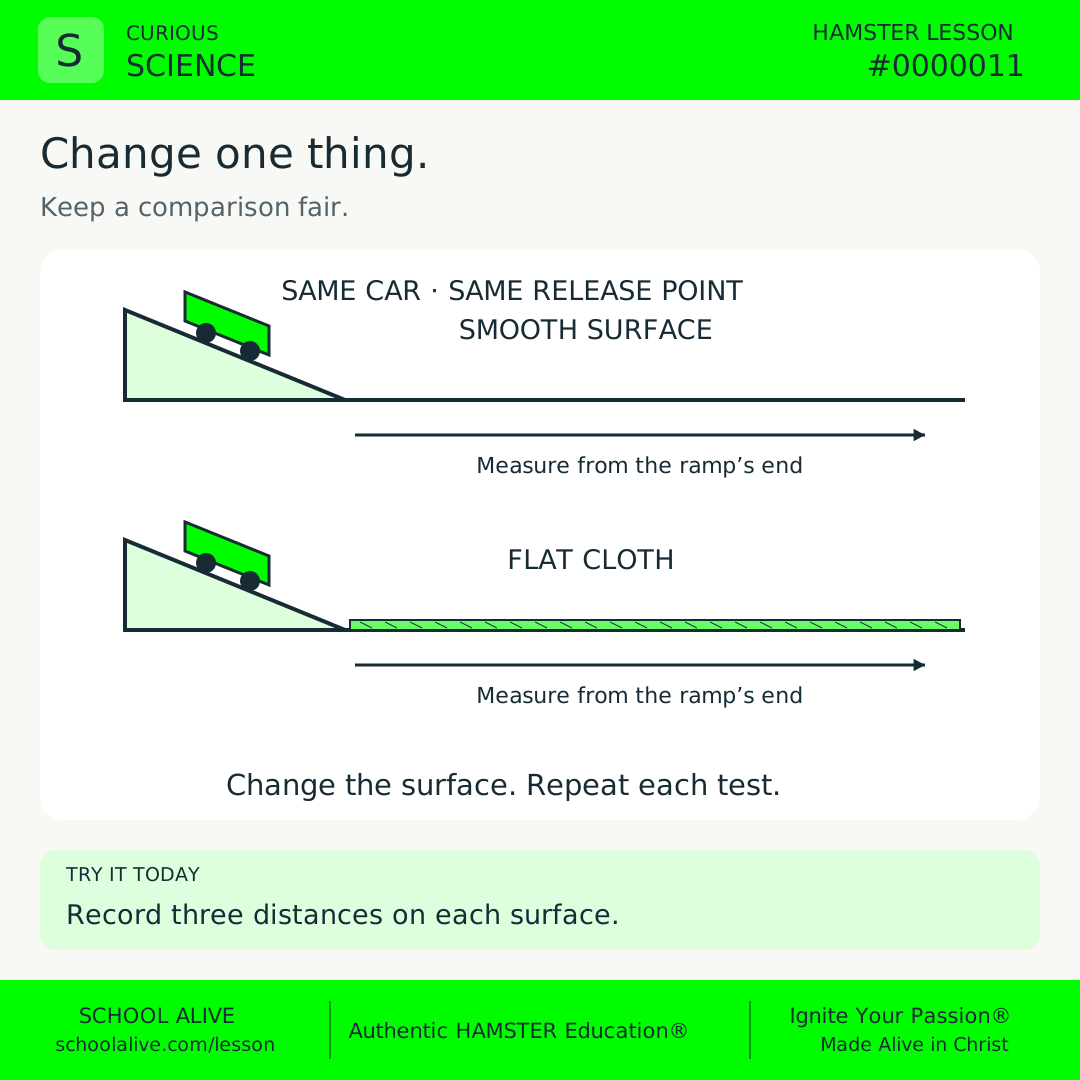
Change the surface while keeping the car, ramp, release point, and measuring method the same. Repeat each test and record every result.
 Change the surface while keeping the car, ramp, release point, and measuring method the same. Repeat each test and record every result.
History
Museo Galileo displays an early nineteenth-century inclined plane built to demonstrate Galileo’s work on motion. Such apparatus connects a scientific idea with measurements people can examine.
 Museo Galileo displays an early nineteenth-century inclined plane built to demonstrate Galileo’s work on motion. Such apparatus connects a scientific idea with measurements people can examine.
Example
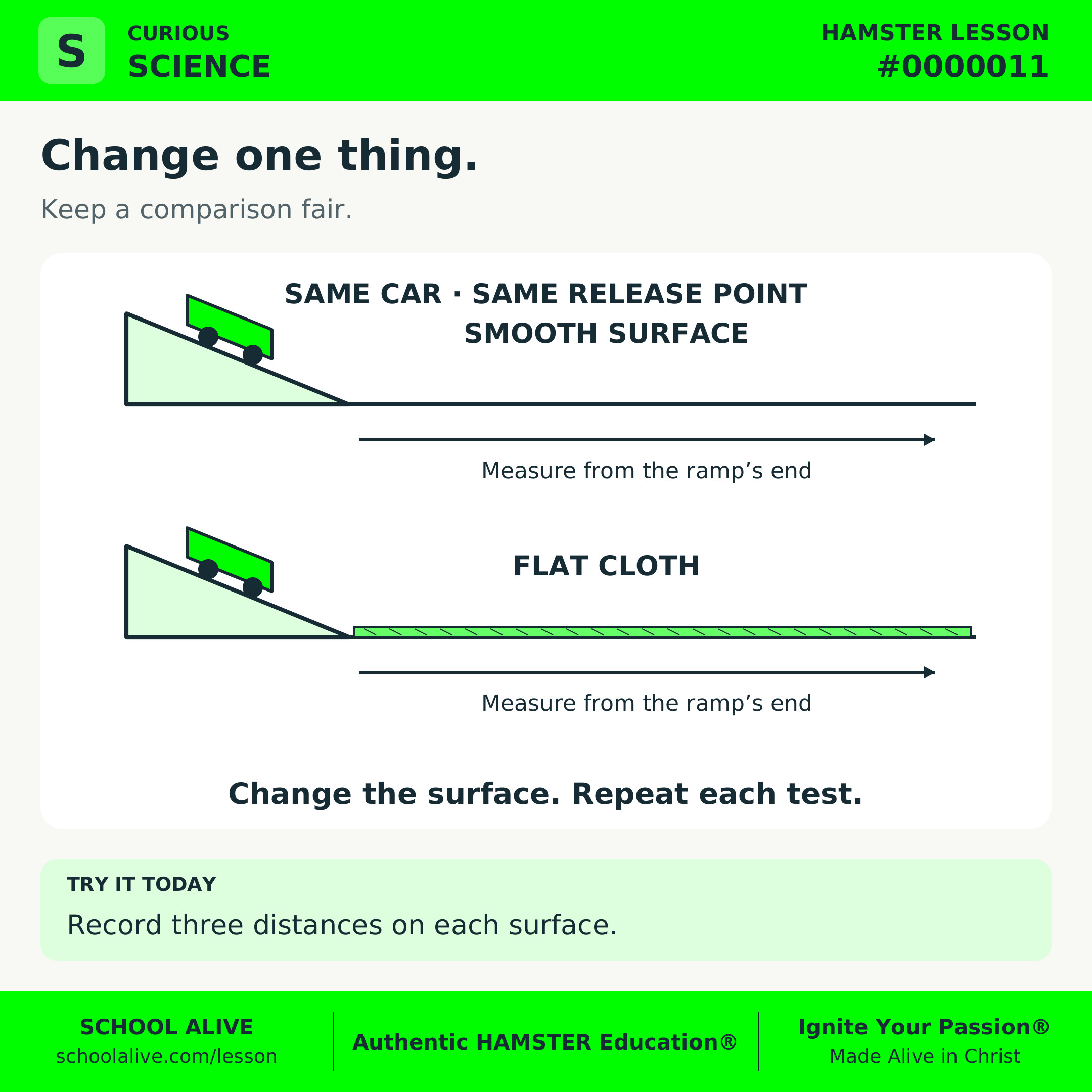
Release one car from a marked place on a low ramp. Measure how far it rolls beyond the ramp on a smooth surface. Then cover that landing surface with a flat cloth and repeat from the same mark.
 Release one car from a marked place on a low ramp. Measure how far it rolls beyond the ramp on a smooth surface. Then cover that landing surface with a flat cloth and repeat from the same mark.
Insight
If you change the surface and push harder at the same time, you cannot tell which change affected the distance. A fair comparison controls the other conditions.
 If you change the surface and push harder at the same time, you cannot tell which change affected the distance. A fair comparison controls the other conditions.
Connection
Scientists and engineers compare evidence when testing materials and designs. Repeated trials help reveal variation; an unexpected result is information to examine, not something to hide.
 Scientists and engineers compare evidence when testing materials and designs. Repeated trials help reveal variation; an unexpected result is information to examine, not something to hide.
Challenge
With an adult, test the same toy car three times on each surface. Release without pushing. Record the six distances in centimeters, compare them, and explain what your evidence suggests.
 With an adult, test the same toy car three times on each surface. Release without pushing. Record the six distances in centimeters, compare them, and explain what your evidence suggests.
Dive deeper
Context
An investigation begins with a question that observations can help answer. Here the question is about one car on two landing surfaces, not every possible car or material.
Understand the idea
Choose the factor you will change before testing. In this comparison, it is the landing surface. Keep the ramp height, release mark, car, and measurement start point constant. Changes in these conditions could offer other explanations for a difference.
Measure from the end of the ramp to the same point on the stopped car each time. Use centimeters for every trial. Record all results, including ones you did not expect. Three trials are a manageable classroom start, not a guarantee that chance and other influences have disappeared.
Compare the pattern and the spread of the distances. If the results overlap, or a cloth wrinkles, describe that uncertainty and improve the method. A conclusion should say what happened in these tests; it should not claim that every smooth surface always makes every car travel farther.
One car, two surfaces
- Use a low, stable cardboard ramp on the floor with adult help. Clear the rolling path and keep it away from stairs. Mark one release position.
- Make a table with surface, trial number, and distance in centimeters. Run three trials on the smooth surface and three with a flat cloth over it, keeping the ramp unchanged.
- Compare all six distances. Explain what stayed the same, what changed, and one limitation. If needed, improve the setup and test again.
Discuss together
- Why would switching cars during the test make the result harder to explain?
- What should you do if the third result is very different from the first two?
Introducing Microlessons
One idea. Seven steps. A practical discovery.
Begin with a question and a clear answer. Explore the history, an example, and a deeper insight. Connect the idea to everyday life, then put it into practice.
Read on your own or talk it through together. Each prepared edition includes a shareable image, concise text, and a one-page PDF.
How the 7 steps work
Each lesson moves from curiosity to understanding to practical action. Here is what each step contributes.
Question
Opens a question worth exploring and gives the lesson a clear purpose.
Answer
Gives a clear starting point that the rest of the lesson helps us understand.
History
Shows how people encountered the idea and how their discoveries shaped what we know.
Example
Makes the idea concrete through a situation, demonstration, or worked example.
Insight
Draws out the deeper principle so we understand why the idea matters.
Connection
Connects the idea to other disciplines, our faith, and everyday life.
Challenge
Turns understanding into action through something to try, practice, or explain.