
Lesson
Measure all the way around.
MCalculated MathematicsMeasure and add a rectangle’s side lengths using one consistent unit.
Perimeter · The distance around a shape.
Question
How much ribbon would reach all the way around a rectangular card?
 How much ribbon would reach all the way around a rectangular card?
Answer
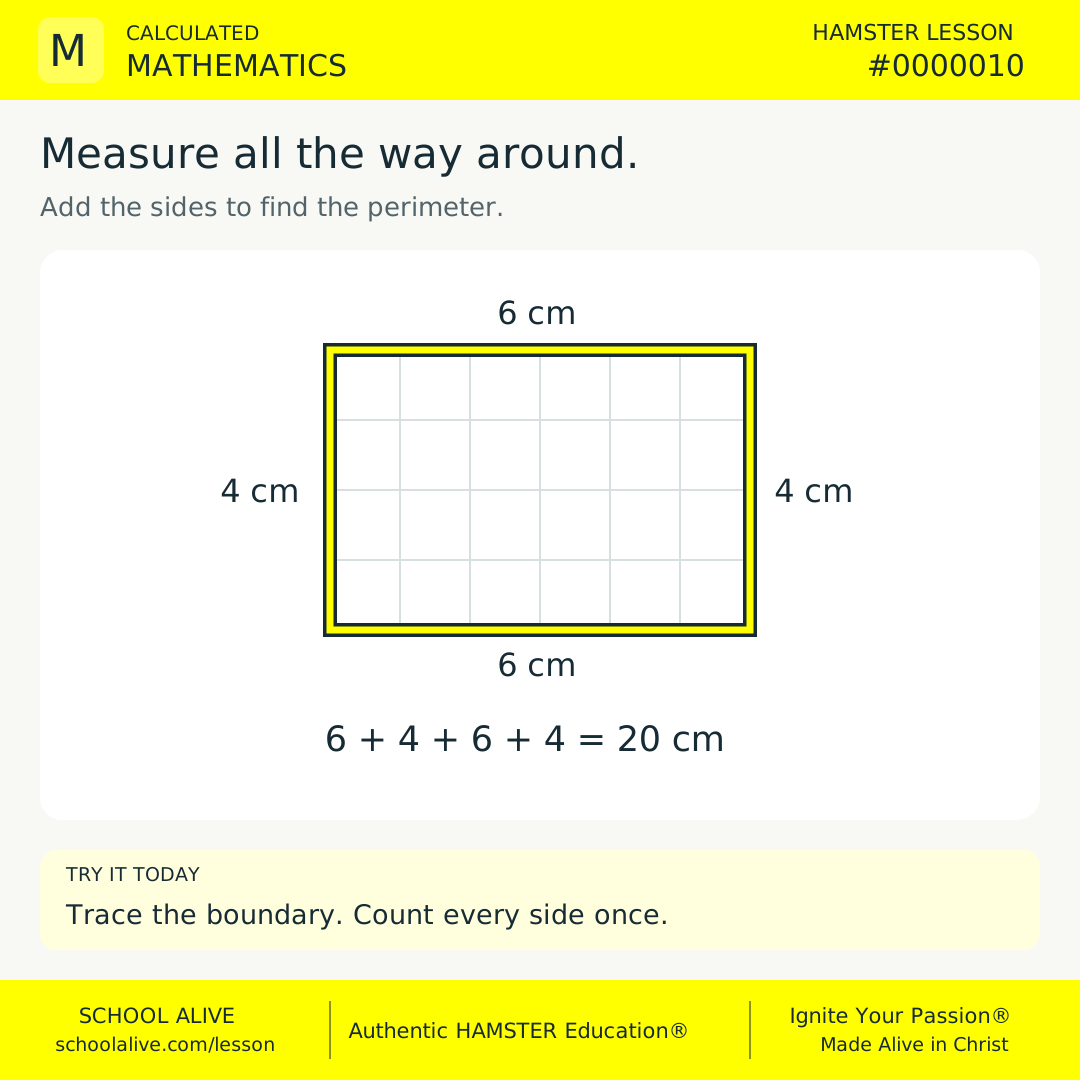
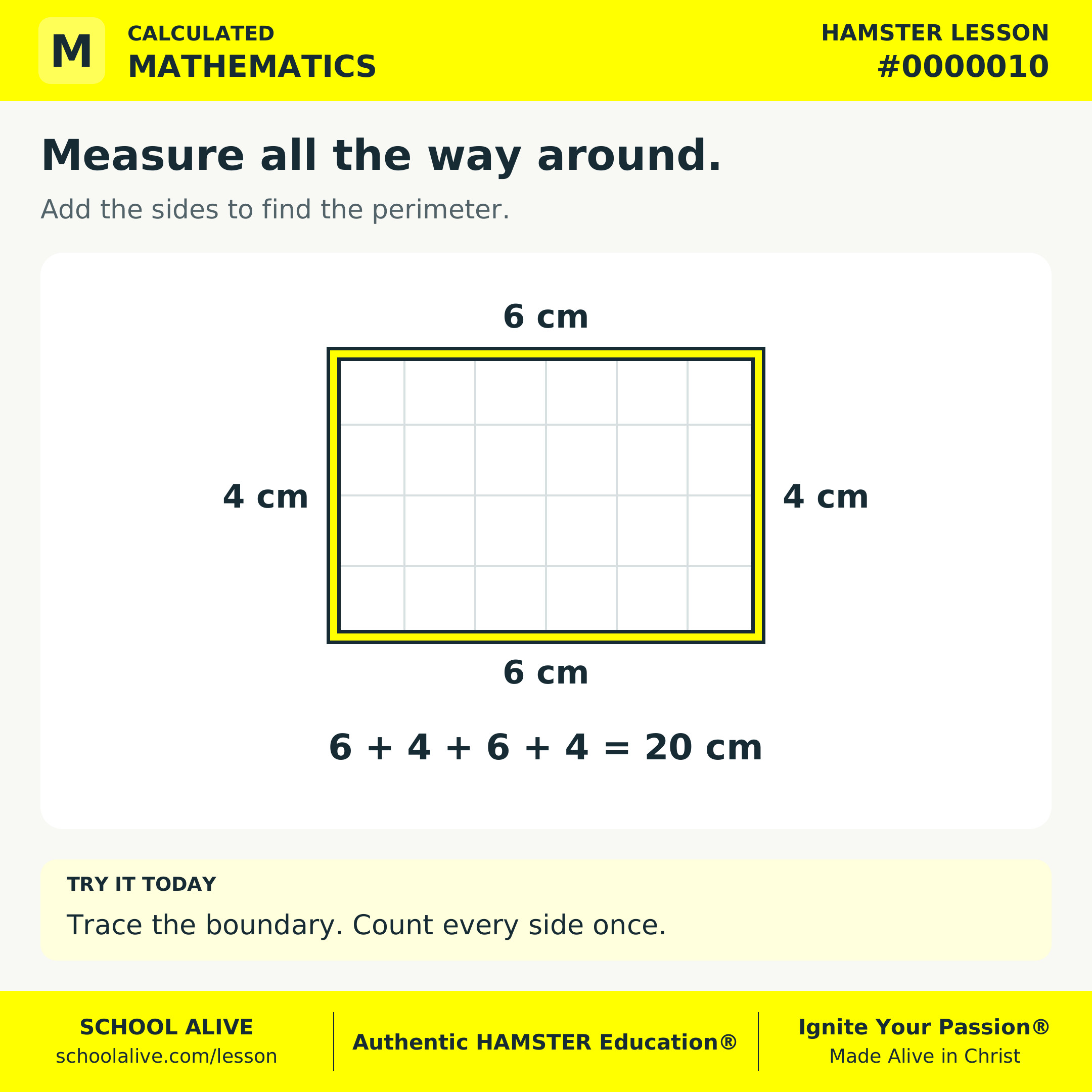
Find its perimeter: the total distance around its outside edge. Add every side once, using the same unit for each measurement.
 Find its perimeter: the total distance around its outside edge. Add every side once, using the same unit for each measurement.
History
The ancient Egyptian Rhind Mathematical Papyrus records practical problems about numbers, building, and shapes. Measuring has long helped people solve real tasks.
 The ancient Egyptian Rhind Mathematical Papyrus records practical problems about numbers, building, and shapes. Measuring has long helped people solve real tasks.
Example
A rectangle 6 cm long and 4 cm wide has perimeter 6 + 4 + 6 + 4 = 20 cm. Count all four sides, even when opposite sides have the same length.
 A rectangle 6 cm long and 4 cm wide has perimeter 6 + 4 + 6 + 4 = 20 cm. Count all four sides, even when opposite sides have the same length.
Insight
Perimeter measures the boundary; area measures the surface inside. A rectangle’s perimeter is 2 × (length + width). Multiplying length by width answers a different question.
 Perimeter measures the boundary; area measures the surface inside. A rectangle’s perimeter is 2 × (length + width). Multiplying length by width answers a different question.
Connection
Perimeter helps us plan ribbon around a card, edging around a garden, or trim around a frame. Real projects may also need extra material for joins or overlap.
 Perimeter helps us plan ribbon around a card, edging around a garden, or trim around a frame. Real projects may also need extra material for joins or overlap.
Challenge
Measure the four edges of a rectangular book cover in centimeters. Write an addition sentence for the perimeter. Check it using twice the length plus twice the width.
 Measure the four edges of a rectangular book cover in centimeters. Write an addition sentence for the perimeter. Check it using twice the length plus twice the width.
Dive deeper
Context
Measurement starts with a clear question: do we need the distance around something or the surface inside it? Perimeter answers how long the whole boundary is.
Understand the idea
Trace the boundary once. Add each side until you return to your starting point. If measurements mix centimeters and meters, convert them before adding.
A rectangle has equal opposite sides. That is why length + width + length + width equals 2 × (length + width). The shortcut still counts all four sides.
Rectangles measuring 6 by 4 cm and 8 by 2 cm both have a perimeter of 20 cm. Their areas are 24 cm² and 16 cm². Perimeter uses length units; area uses square units.
Two shapes, one perimeter
- Draw rectangles measuring 6 by 4 cm and 8 by 2 cm. Label all four sides.
- Trace each boundary with a finger and add the lengths. Explain why both perimeters are 20 cm.
- Count or draw the 1 cm squares inside. Compare the areas and explain why measuring the edge does not measure the inside.
Discuss together
- Why must you count all four sides and use one unit?
- Would you use perimeter or area to buy ribbon? What about paper to cover the card?
Introducing Microlessons
One idea. Seven steps. A practical discovery.
Begin with a question and a clear answer. Explore the history, an example, and a deeper insight. Connect the idea to everyday life, then put it into practice.
Read on your own or talk it through together. Each prepared edition includes a shareable image, concise text, and a one-page PDF.
How the 7 steps work
Each lesson moves from curiosity to understanding to practical action. Here is what each step contributes.
Question
Opens a question worth exploring and gives the lesson a clear purpose.
Answer
Gives a clear starting point that the rest of the lesson helps us understand.
History
Shows how people encountered the idea and how their discoveries shaped what we know.
Example
Makes the idea concrete through a situation, demonstration, or worked example.
Insight
Draws out the deeper principle so we understand why the idea matters.
Connection
Connects the idea to other disciplines, our faith, and everyday life.
Challenge
Turns understanding into action through something to try, practice, or explain.