
Lesson
Can water climb?
SCurious ScienceNotice how water moves through small spaces.
Physical science · Explore capillary action by observing how water travels through a paper towel.
Question
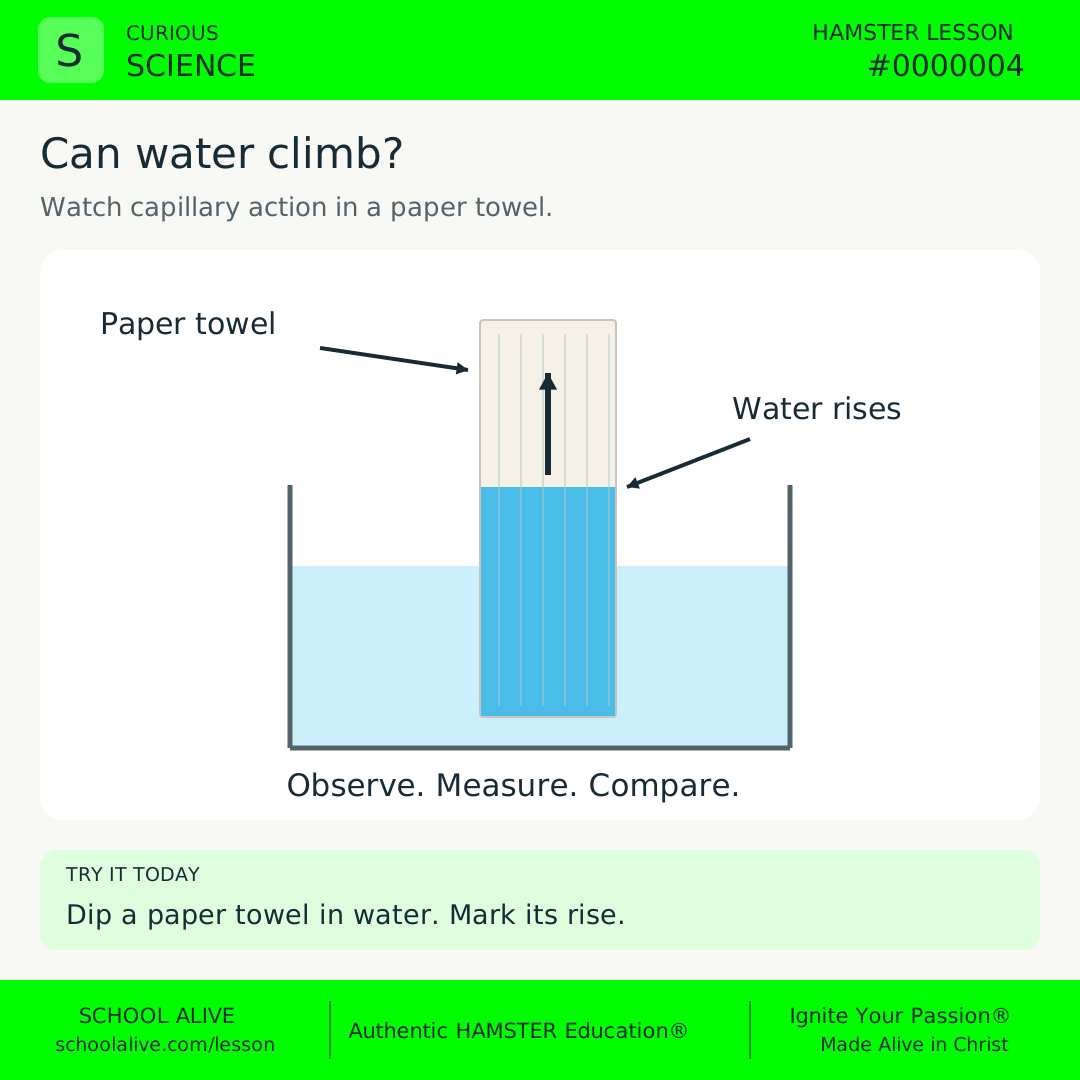
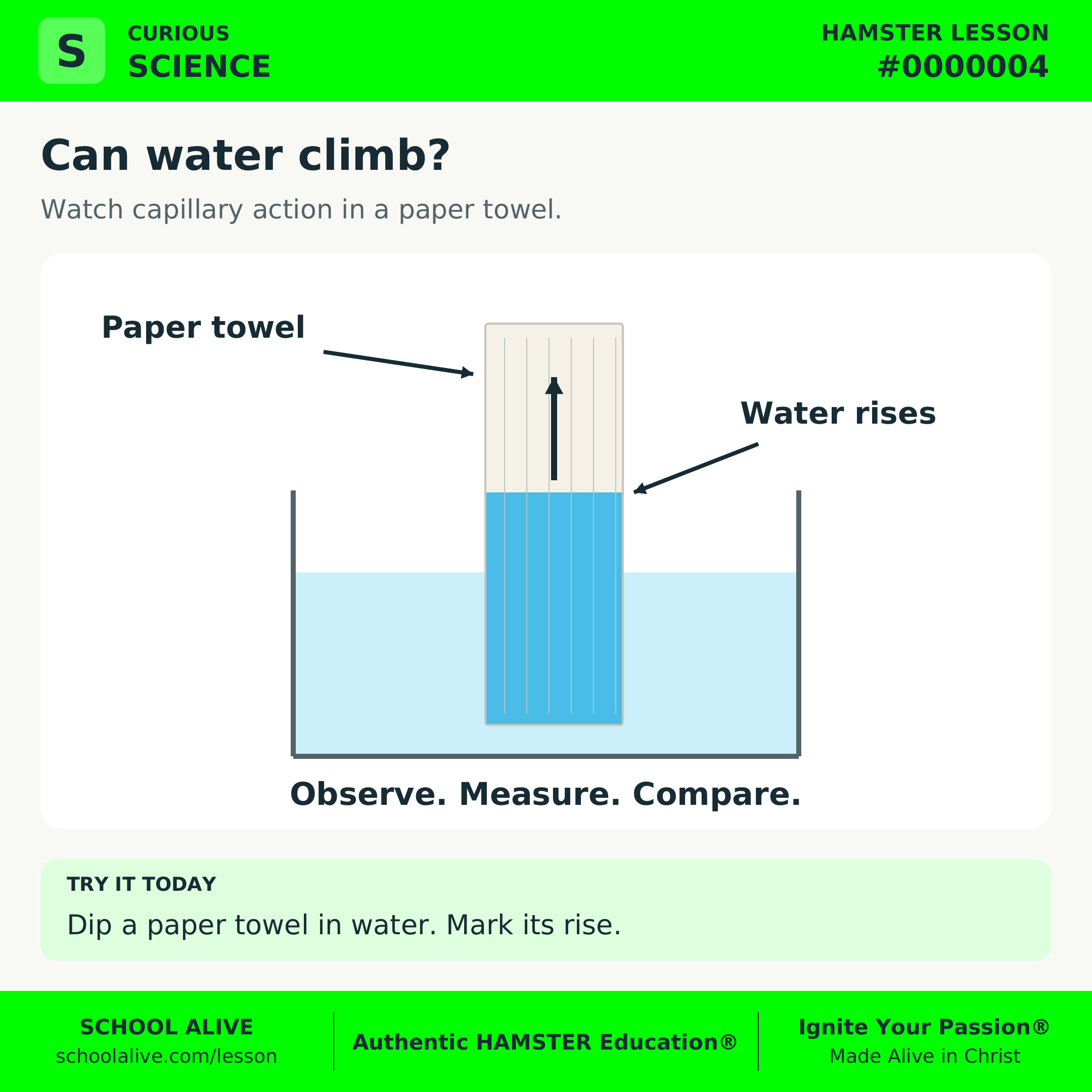
Why does water travel up a paper towel when only the bottom touches the water?
 Why does water travel up a paper towel when only the bottom touches the water?
Answer
Capillary action allows water to move through tiny spaces, sometimes against gravity.
 Capillary action allows water to move through tiny spaces, sometimes against gravity.
History
Ancient Romans used oil lamps with wicks made from materials such as linen. A wick draws liquid fuel toward the flame by capillary action, putting this principle to work long before electric lighting.
 Ancient Romans used oil lamps with wicks made from materials such as linen. A wick draws liquid fuel toward the flame by capillary action, putting this principle to work long before electric lighting.
Example
Water is attracted to the towel's fibers: adhesion. Water molecules also attract one another: cohesion. These interactions, together with surface tension, help water move through the towel's tiny spaces.
 Water is attracted to the towel's fibers: adhesion. Water molecules also attract one another: cohesion. These interactions, together with surface tension, help water move through the towel's tiny spaces.
Insight
Gravity still acts. The height water reaches depends on the material and its tiny spaces. Capillary action helps water move in plants, but other processes also help water reach the tops of tall trees.
 Gravity still acts. The height water reaches depends on the material and its tiny spaces. Capillary action helps water move in plants, but other processes also help water reach the tops of tall trees.
Connection
The same principle helps explain absorbent materials and the movement of water through soil. Everyday objects can invite us to investigate the order and detail of God’s creation.
 The same principle helps explain absorbent materials and the movement of water through soil. Everyday objects can invite us to investigate the order and detail of God’s creation.
Challenge
Cut equal-sized strips from two types of paper towel. Fill matching cups to the same level with colored water. Dip both strips equally deep and mark the wet edges after one, three, and five minutes. Compare heights. What does your test suggest?
 Cut equal-sized strips from two types of paper towel. Fill matching cups to the same level with colored water. Dip both strips equally deep and mark the wet edges after one, three, and five minutes. Compare heights. What does your test suggest?
Dive deeper
Context
A paper towel is a network of fibers with tiny spaces between them. Water can move through those spaces by capillary action, so the wet edge can rise above the water level in a cup.
Understand the idea
Adhesion is attraction between water and another material; cohesion is attraction among water molecules. Together with surface tension, these interactions help explain movement through narrow spaces. Gravity continues to act, so water does not climb without limit.
A useful investigation changes one thing at a time. If you change the towel material, strip width, and dipping depth together, you cannot tell which change explains the result. Measure what happens instead of deciding from a single quick glance.
Try a fair comparison
- Cut equal-width strips from two kinds of paper towel. Use the same water, dipping depth, and timing for both.
- Measure the wet height above the waterline after one minute and again after three minutes. Record your results.
- Repeat with fresh strips. Did the same material rise farther each time? Describe the evidence before suggesting an explanation.
Discuss together
- What did you keep the same so the comparison would be fair?
- What would repeated trials tell you that one trial could not?
Introducing Microlessons
One idea. Seven steps. A practical discovery.
Begin with a question and a clear answer. Explore the history, an example, and a deeper insight. Connect the idea to everyday life, then put it into practice.
Read on your own or talk it through together. Each prepared edition includes a shareable image, concise text, and a one-page PDF.
How the 7 steps work
Each lesson moves from curiosity to understanding to practical action. Here is what each step contributes.
Question
Opens a question worth exploring and gives the lesson a clear purpose.
Answer
Gives a clear starting point that the rest of the lesson helps us understand.
History
Shows how people encountered the idea and how their discoveries shaped what we know.
Example
Makes the idea concrete through a situation, demonstration, or worked example.
Insight
Draws out the deeper principle so we understand why the idea matters.
Connection
Connects the idea to other disciplines, our faith, and everyday life.
Challenge
Turns understanding into action through something to try, practice, or explain.