
More word-for-word → more thought-for-thought.
Approximate order. AMP includes added explanations.
Question
Where can we find protection when doing right feels costly?
Answer
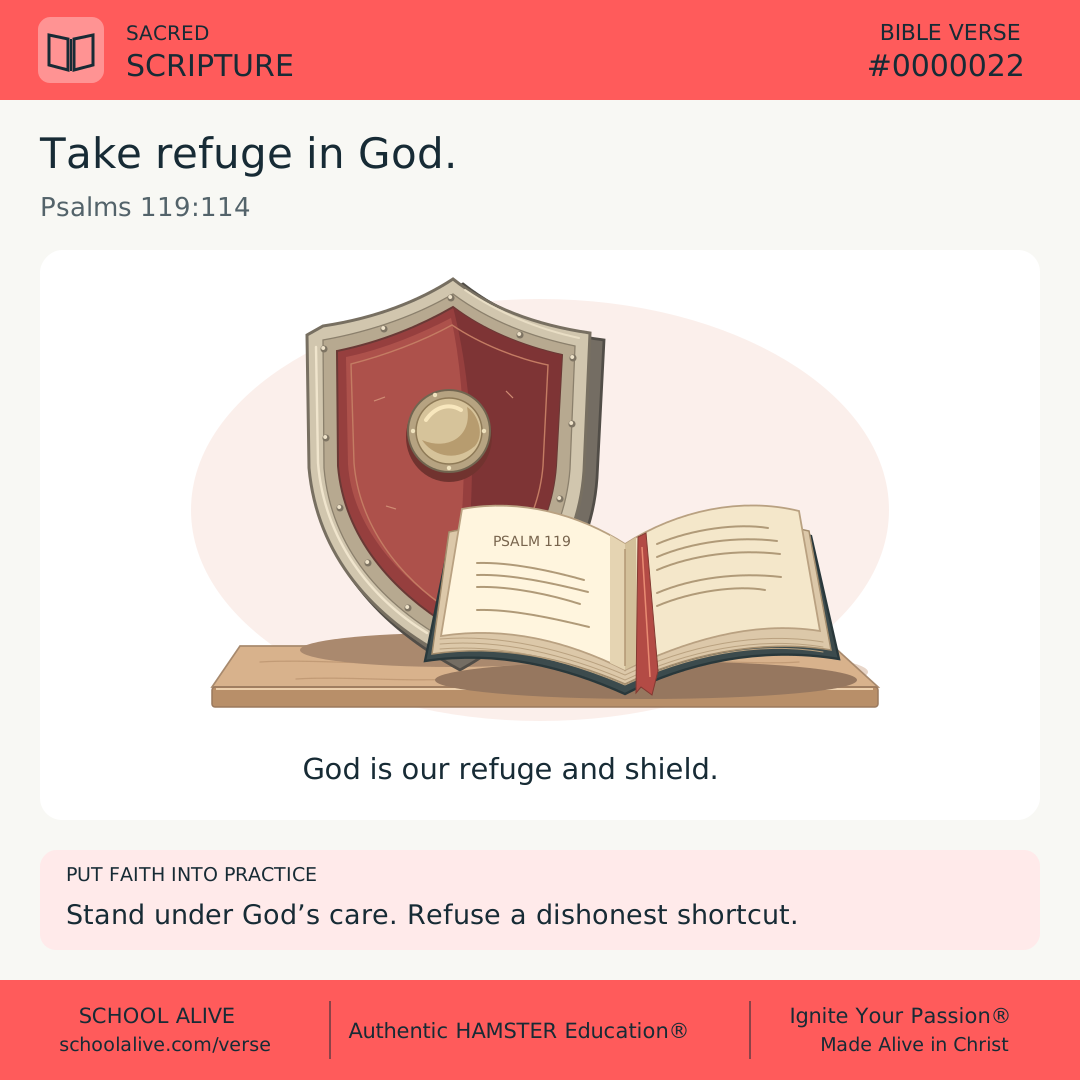
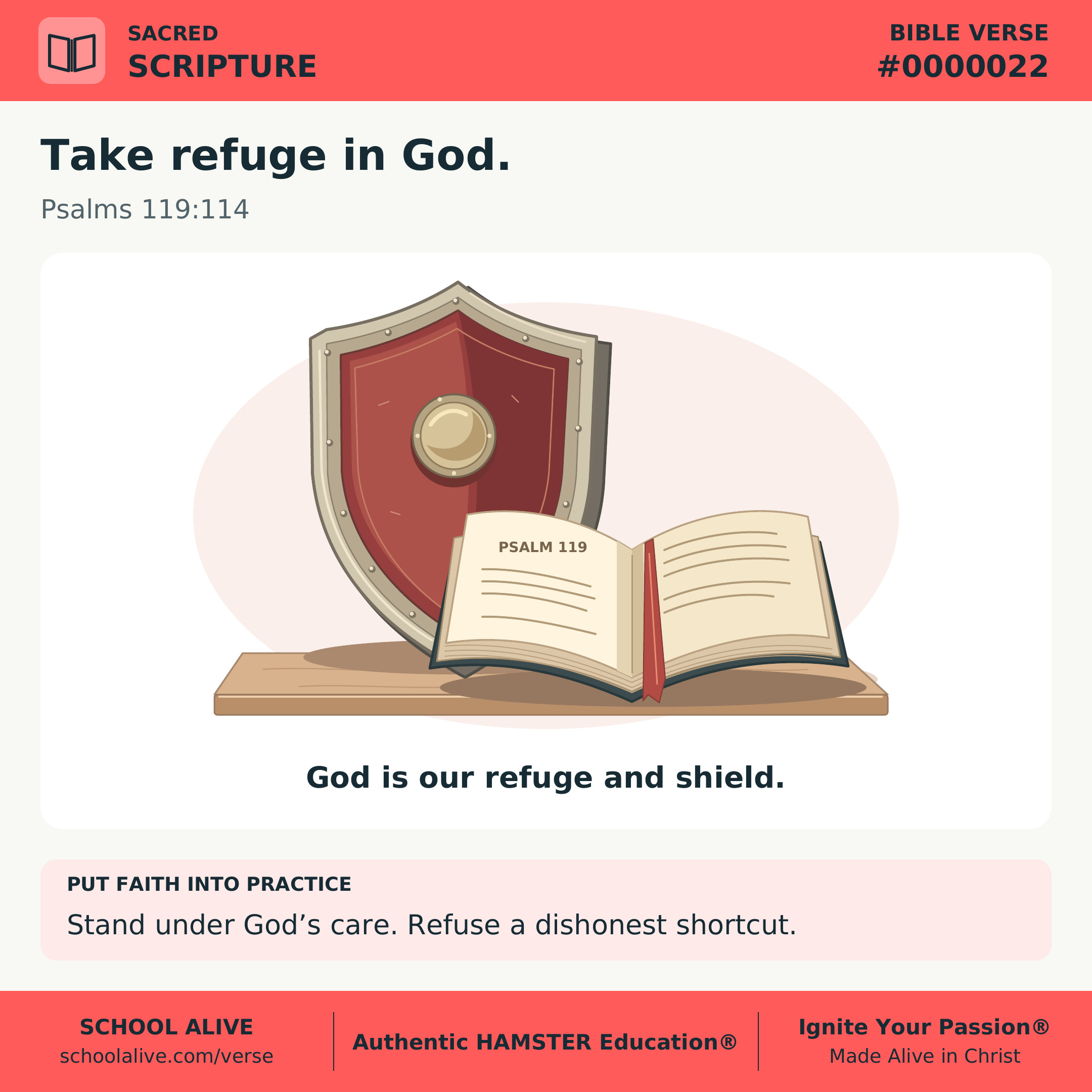
God Himself is our refuge and shield. Hope in His word, seek His help through Jesus, and refuse the false safety of wrongdoing.
Scripture 1
“You are my refuge and my shield; I have put my hope in your word” (Psalms 119:114, NIV). God is our shelter and protector; His word gives us a firm place for hope.
Scripture 2
“God is our refuge and strength, an ever-present help in trouble” (Psalms 46:1, NIV). God remains present to help His people when trouble comes.
Scripture 3
“Let us then approach God’s throne of grace with confidence, so that we may receive mercy and find grace to help us in our time of need” (Hebrews 4:16, NIV). Through Jesus, we can approach God for mercy and timely grace.
Prayer
Father, be our refuge and shield. Through Jesus, give us courage to tell the truth and trust Your care under pressure. Amen.
Challenge
If you face pressure to conceal or falsify a fact today, refuse the shortcut and offer an honest alternative: “I can’t change that result, but I can help address the problem honestly.” Pray, “God, You are my refuge and shield; help me trust You rather than a lie.” If no such request arises, make this boundary clear in one responsibility you share with others. Let God’s care be your protection as you tell the truth.
 Where can we find protection when doing right feels costly?
 God Himself is our refuge and shield. Hope in His word, seek His help through Jesus, and refuse the false safety of wrongdoing.
 “You are my refuge and my shield; I have put my hope in your word” (
 Father, be our refuge and shield. Through Jesus, give us courage to tell the truth and trust Your care under pressure. Amen.
 If you face pressure to conceal or falsify a fact today, refuse the shortcut and offer an honest alternative: “I can’t change that result, but I can help address the problem honestly.” Pray, “God, You are my refuge and shield; help me trust You rather than a lie.” If no such request arises, make this boundary clear in one responsibility you share with others. Let God’s care be your protection as you tell the truth.
Dive deeper
Context
Old Testament · Psalm 119 is an extended prayer celebrating God’s instruction, arranged in sections following the Hebrew alphabet. Its human author is not identified in the psalm. In verses 113–120, the speaker rejects divided loyalty, asks God for sustaining help, and resolves to keep His commands despite evildoers. Verse 114 addresses God Himself as refuge and shield, placing hope in His word. This prayer gave Israel’s worshipers language for faithful dependence under pressure, and continues to teach God’s people to trust and obey Him.
Read the surrounding passage →Meaning
The psalmist says that God is his refuge and shield. A refuge is a place of shelter; a shield is protection in the face of danger. Both images direct our confidence toward the Lord Himself. The second half of the verse explains the response: the speaker places hope in God’s word. Scripture is not a charm that guarantees an easy day, and faith does not make sensible precautions unnecessary. God’s trustworthy character and promises sustain His people when circumstances or other people press against them.
The surrounding verses connect this shelter with faithful obedience. The psalmist rejects divided loyalty and tells evildoers to leave so that he may keep God’s commands. He then asks God to uphold him. He does not treat obedience as self-sufficiency; he needs God’s help to stand. Psalm 46:1 reinforces this dependence amid trouble. Hebrews 4:16 shows how believers approach God through Jesus for the mercy and grace they need. Our refuge is personal communion with the living God, not escape into wishful thinking.
Pressure can make a dishonest shortcut look like protection: changing a result, concealing a relevant fact, or agreeing to wrongdoing so others will accept us. Psalm 119 points us toward a better shelter. We can entrust our standing and future to God while refusing the false safety that disobedience offers. A calm refusal, followed by a truthful alternative, puts that trust into practice. We may still face disappointment or opposition; this passage does not promise otherwise. It teaches us where to place our hope as we keep doing what is right.
Original language · Biblical Hebrew
סִתְרִ֣י וּמָגִנִּ֣י אָ֑תָּה לִדְבָרְךָ֥ יִחָֽלְתִּי׃Text of the Masoretic tradition, preserved in the Leningrad Codex. Text: AO Lab · Edition & rights
The supplied text is from the Westminster Leningrad Codex. The psalmist addresses God personally as shelter and protector, then places hope in His word.
- סִתְרִ֣י (sitrî) · my hiding place / my refuge Strong’s H5643 · dictionary entry, opens another tab
- This is a form of sēter with a suffix meaning “my.” Brown–Driver–Briggs identifies the noun as a covering or hiding place and includes this verse among passages picturing God as shelter. The context gives the shelter its personal meaning: the speaker turns to God while seeking to keep His commands.
- וּמָגִנִּ֣י (ûmāginnî) · and my shield Strong’s H4043 · dictionary entry, opens another tab
- The noun māgēn names a shield, here with “and” and “my.” Brown–Driver–Briggs lists Psalm 119:114 among figurative uses for God as the defense of His servants. The image expresses dependence on Him; it does not promise immunity from every hardship.
The psalmist finds shelter in God Himself. Trust His care and His word while holding fast to faithful obedience.
Language sources: Brown–Driver–Briggs / Strong’s H5643: sēter · Brown–Driver–Briggs / Strong’s H4043: māgēn
Discuss together
What dishonest shortcut can feel like a shelter from embarrassment or rejection? How could a truthful refusal express trust in God without becoming harsh or self-righteous?
Ignite Your Passion®
Made Alive in Christ
Reflection prepared by School Alive.
The Holy Bible, New International Version® NIV® Copyright © 1973, 1978, 1984, 2011 by Biblica, Inc.® Used by Permission of Biblica, Inc.® All rights reserved worldwide. Copyright & permissions