
Lesson
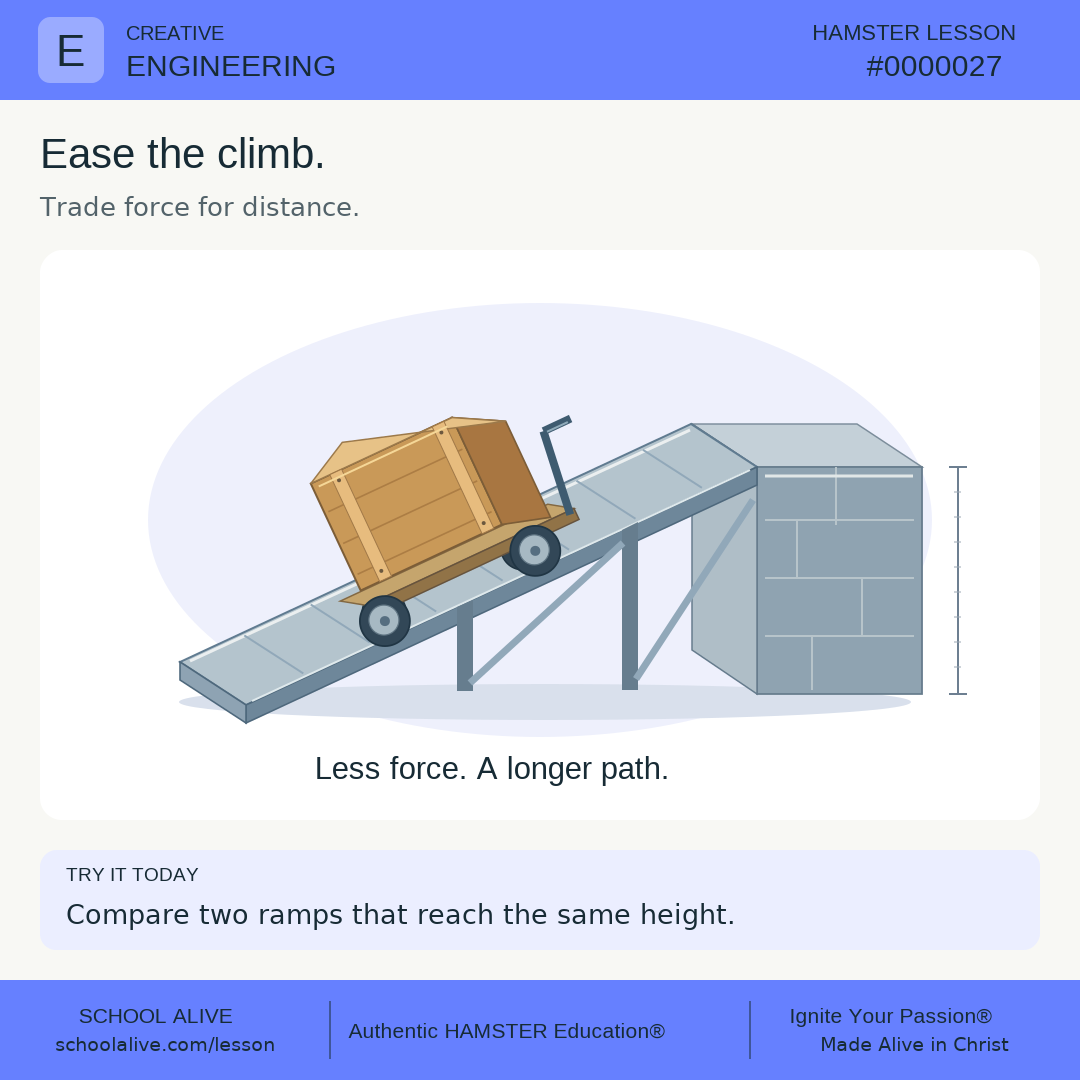
Ease the climb.
ECreative EngineeringCompare two ramps that reach the same height and explain the tradeoff between force and distance.
Mechanical engineering · Inclined planes, effort, and design tradeoffs.
Question
Why can a longer ramp make a load easier to raise?
 Why can a longer ramp make a load easier to raise?
Answer
A ramp lets a load reach a height along a sloping path. For the same load and height, a longer, gentler ramp needs less force along the slope in an ideal model without friction.
 A ramp lets a load reach a height along a sloping path. For the same load and height, a longer, gentler ramp needs less force along the slope in an ideal model without friction.
History
The FAA’s Airframe and Powerplant Mechanics General Handbook teaches the inclined plane with a barrel-and-ramp example. The principle connects a familiar loading task with the mechanics used in technical work.
 The FAA’s Airframe and Powerplant Mechanics General Handbook teaches the inclined plane with a barrel-and-ramp example. The principle connects a familiar loading task with the mechanics used in technical work.
Example
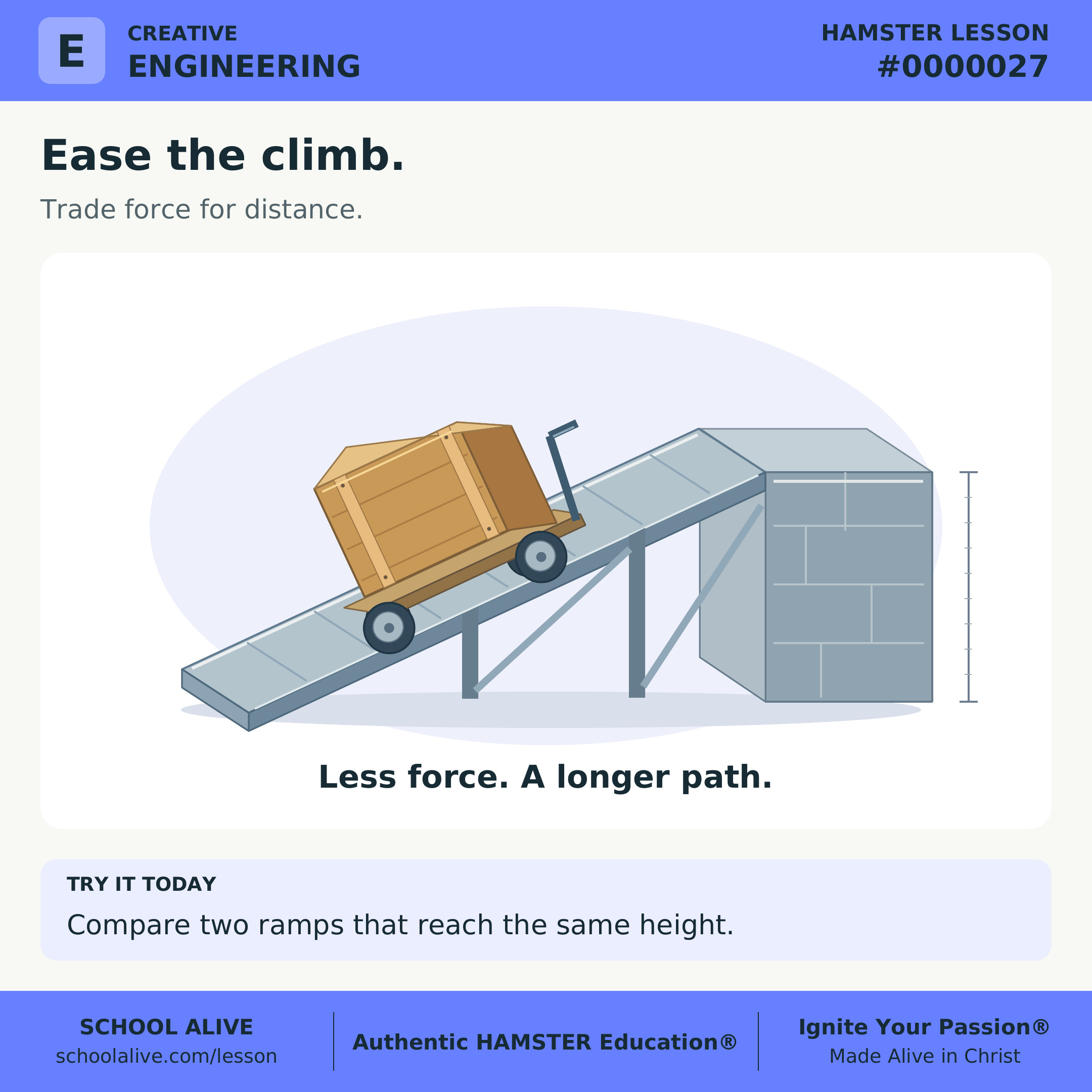
Compare a short ramp and a longer ramp reaching the same low platform. The longer ramp is less steep. Pulling the same toy cart up it can feel easier, but the cart must travel farther.
 Compare a short ramp and a longer ramp reaching the same low platform. The longer ramp is less steep. Pulling the same toy cart up it can feel easier, but the cart must travel farther.
Insight
A ramp does not create energy. In an ideal model, the smaller force acts over a longer distance. Real ramps also involve friction, stability, and space.
 A ramp does not create energy. In an ideal model, the smaller force acts over a longer distance. Real ramps also involve friction, stability, and space.
Connection
Engineers weigh several needs at once: manageable effort, available space, a stable surface, and a secure load. The gentlest slope may not fit the site, so a good design considers the whole task.
 Engineers weigh several needs at once: manageable effort, available space, a stable surface, and a secure load. The gentlest slope may not fit the site, so a good design considers the whole task.
Challenge
Today, compare two sturdy tabletop ramps reaching the same low height. Gently pull a small toy cart up each at a steady speed. Record the ramp lengths and compare the effort. Choose a design and explain what you gain and give up.
 Today, compare two sturdy tabletop ramps reaching the same low height. Gently pull a small toy cart up each at a steady speed. Record the ramp lengths and compare the effort. Choose a design and explain what you gain and give up.
Dive deeper
Context
An inclined plane is a sloping surface that connects different heights. A ramp changes how a load is raised; it does not change the height it must gain. This small model lets us compare a design change while keeping the load and destination the same.
Understand the idea
Imagine raising one load slowly to a fixed height, ignoring friction. The longer the ramp, the smaller the pulling force needed parallel to it. The ideal relationship is force = weight × height ÷ ramp length. A ramp four times as long as its rise needs one-quarter of the load’s weight as pulling force in this model. Ramp length means the sloping travel distance, not its horizontal footprint.
The gain in force comes with extra travel. For the same load and rise, ideal lifting work stays the same: force multiplied by distance. In an actual test, wheels, rubbing surfaces, bends, and uneven motion affect effort. Use the same cart and surface, keep the rise fixed, and move slowly. If you have no force meter, describe the effort as a comparison; do not present a feeling as a precise measurement.
A successful ramp must do more than reduce effort. Consider where it begins and ends, whether its supports stay put, and whether a load can move without tipping or slipping. A longer route takes more room. The model invites an engineering question: which arrangement meets the task within the available space? A tabletop experiment illustrates the tradeoff; full-size ramps require appropriate design standards and materials.
Compare two paths to one height
- Choose a small toy cart, a low stable platform, and two stiff boards of different lengths with similar smooth surfaces. Secure each ramp so it cannot slip, and keep the test close to the tabletop.
- Measure the platform’s height and each ramp’s sloping length. Predict which ramp will need less pulling force. Keep the same cart and load for both tests.
- Pull the cart slowly up each ramp, parallel to the slope. Compare the effort and travel distance. If using a suitable spring scale, record its steady reading in newtons; otherwise use descriptions such as easier or harder.
- Sketch both ramps reaching the same height. Label their lengths, then choose one for a task with limited floor space. Explain your choice using effort, distance, and room needed.
Discuss together
- What must stay the same for our comparison to test ramp length fairly?
- Why might a designer choose a shorter ramp even though a longer one reduces ideal pulling force?
Introducing Microlessons
One idea. Seven steps. A practical discovery.
Begin with a question and a clear answer. Explore the history, an example, and a deeper insight. Connect the idea to everyday life, then put it into practice.
Read on your own or talk it through together. Each prepared edition includes a shareable image, concise text, and a one-page PDF.
How the 7 steps work
Each lesson moves from curiosity to understanding to practical action. Here is what each step contributes.
Question
Opens a question worth exploring and gives the lesson a clear purpose.
Answer
Gives a clear starting point that the rest of the lesson helps us understand.
History
Shows how people encountered the idea and how their discoveries shaped what we know.
Example
Makes the idea concrete through a situation, demonstration, or worked example.
Insight
Draws out the deeper principle so we understand why the idea matters.
Connection
Connects the idea to other disciplines, our faith, and everyday life.
Challenge
Turns understanding into action through something to try, practice, or explain.