
Lesson
Share into equal groups.
MCalculated MathematicsModel equal sharing and check it with multiplication.
Division · Find how many belong in each equal group.
Question
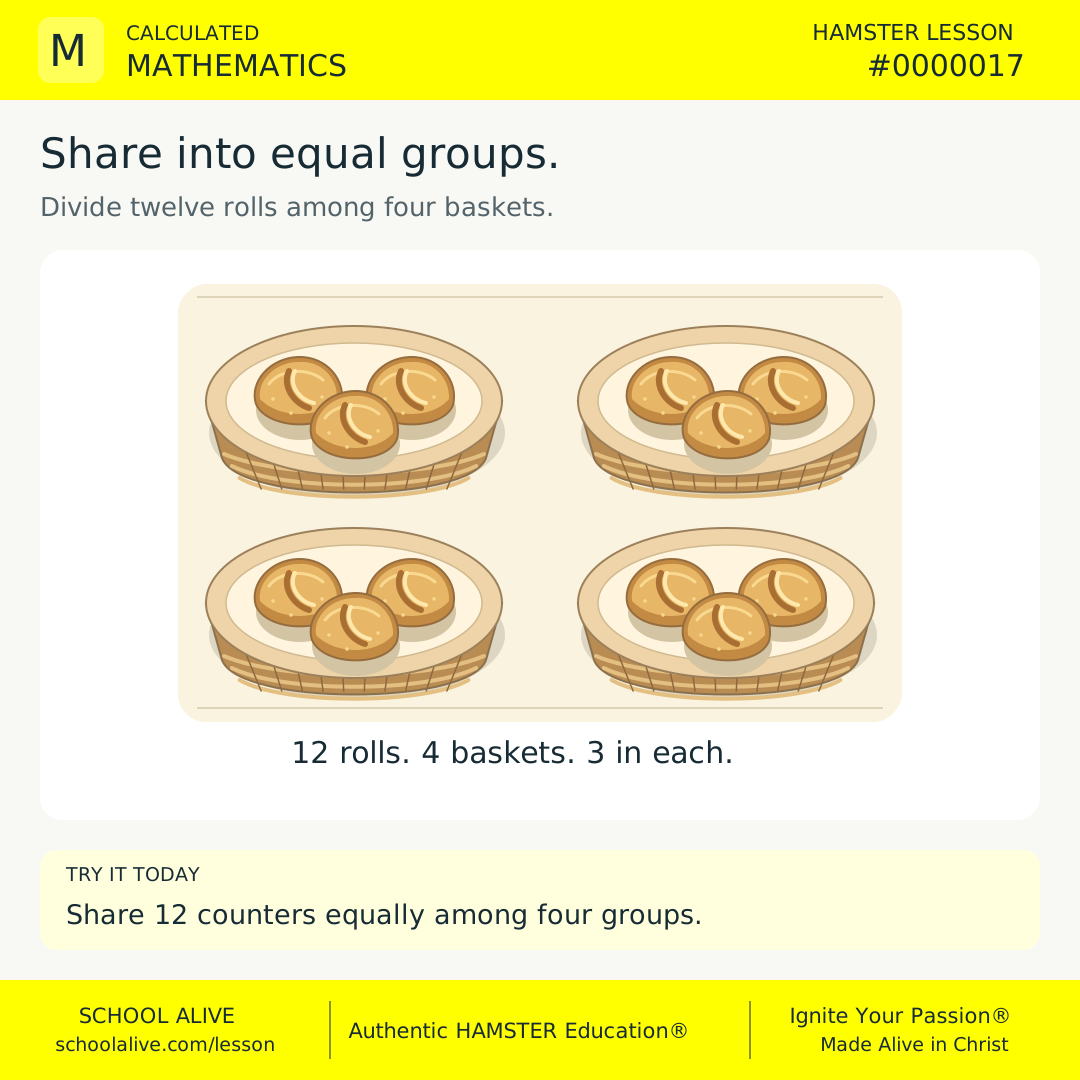
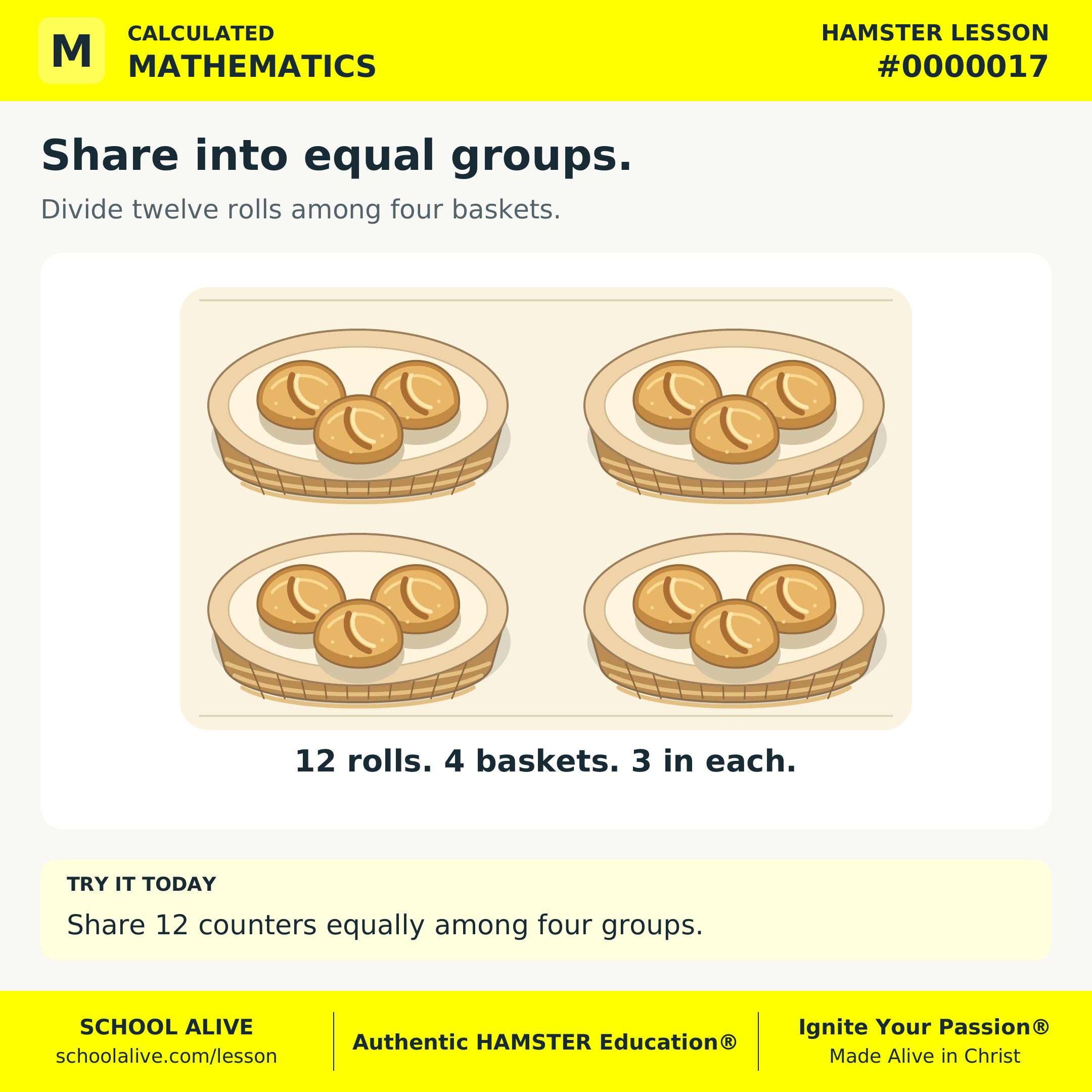
How many rolls go in each basket when twelve are shared equally among four baskets?
 How many rolls go in each basket when twelve are shared equally among four baskets?
Answer
Put the same number in every basket and use all twelve rolls. Each basket receives three: 12 ÷ 4 = 3.
 Put the same number in every basket and use all twelve rolls. Each basket receives three: 12 ÷ 4 = 3.
History
The division sign ÷ appeared in Johann Rahn’s algebra book in 1659. Mathematical symbols help us record an operation, but a picture or a story explains what its numbers mean.
 The division sign ÷ appeared in Johann Rahn’s algebra book in 1659. Mathematical symbols help us record an operation, but a picture or a story explains what its numbers mean.
Example
Place one roll in each of four baskets. Repeat until all twelve are used. Count three rolls in every basket, then check: 4 × 3 = 12.
 Place one roll in each of four baskets. Repeat until all twelve are used. Count three rolls in every basket, then check: 4 × 3 = 12.
Insight
In this sharing problem, we know the total and the number of groups. Division finds the size of each group; multiplication combines the equal groups to recover the total.
 In this sharing problem, we know the total and the number of groups. Division finds the size of each group; multiplication combines the equal groups to recover the total.
Connection
Equal sharing helps us distribute classroom supplies or plan portions. Counting carefully makes our plan clear; real people may also have different needs that call for thoughtful care.
 Equal sharing helps us distribute classroom supplies or plan portions. Counting carefully makes our plan clear; real people may also have different needs that call for thoughtful care.
Challenge
Draw four circles and share twelve counters among them, one per circle each round. Label 12 ÷ 4 = 3. Then rearrange the same counters into three equal groups and explain what changed.
 Draw four circles and share twelve counters among them, one per circle each round. Label 12 ÷ 4 = 3. Then rearrange the same counters into three equal groups and explain what changed.
Dive deeper
Context
Imagine packing twelve rolls for four tables. We want every table to receive the same number, with none left on the counter. This story gives meaning to a division calculation.
Understand the idea
Label what each number describes: twelve rolls in total, four baskets, and three rolls per basket. A correct answer includes its meaning. Here the answer is three rolls per basket, not three baskets.
Check the picture before the equation. Count every roll once and compare all four groups. Then add 3 + 3 + 3 + 3 or multiply 4 × 3. Both checks should return twelve. Moving the rolls does not change their total.
Now use the same twelve counters with only three circles. Each circle receives four. The total stays twelve, but fewer groups receive more counters each. If you try five circles while keeping counters whole, two in each leaves two over; say what remains instead of silently dropping them.
Share, label, and check
- Count twelve counters or draw twelve small paper rolls. Make four circles on a page to stand for baskets.
- Deal one counter to each circle in turn until none remain. Count each group and write the division and multiplication equations.
- Collect the counters and try three circles. Explain why each group now has four. Optional: try five circles and describe the leftover counters.
Discuss together
- Why is 4 × 3 a useful check for 12 ÷ 4?
- What does each number mean when the same twelve counters are shared among three groups?
Introducing Microlessons
One idea. Seven steps. A practical discovery.
Begin with a question and a clear answer. Explore the history, an example, and a deeper insight. Connect the idea to everyday life, then put it into practice.
Read on your own or talk it through together. Each prepared edition includes a shareable image, concise text, and a one-page PDF.
How the 7 steps work
Each lesson moves from curiosity to understanding to practical action. Here is what each step contributes.
Question
Opens a question worth exploring and gives the lesson a clear purpose.
Answer
Gives a clear starting point that the rest of the lesson helps us understand.
History
Shows how people encountered the idea and how their discoveries shaped what we know.
Example
Makes the idea concrete through a situation, demonstration, or worked example.
Insight
Draws out the deeper principle so we understand why the idea matters.
Connection
Connects the idea to other disciplines, our faith, and everyday life.
Challenge
Turns understanding into action through something to try, practice, or explain.