
Lesson
Make room for rest.
HCaring HealthcareBuild a realistic bedtime routine with a trusted adult.
Healthy habits · Learn why sleep supports learning and plan a calmer end to the day.
Question
Why does our body need sleep even after a quiet day?
 Why does our body need sleep even after a quiet day?
Answer
Sleep supports our brain and body. It helps us learn, form memories, and grow. Rest is part of caring for ourselves, not a reward we must earn.
 Sleep supports our brain and body. It helps us learn, form memories, and grow. Rest is part of caring for ourselves, not a reward we must earn.
History
In 1953, Eugene Aserinsky and Nathaniel Kleitman reported repeating periods of rapid eye movement during sleep. Their observations helped show that sleep contains different kinds of activity.
 In 1953, Eugene Aserinsky and Nathaniel Kleitman reported repeating periods of rapid eye movement during sleep. Their observations helped show that sleep contains different kinds of activity.
Example
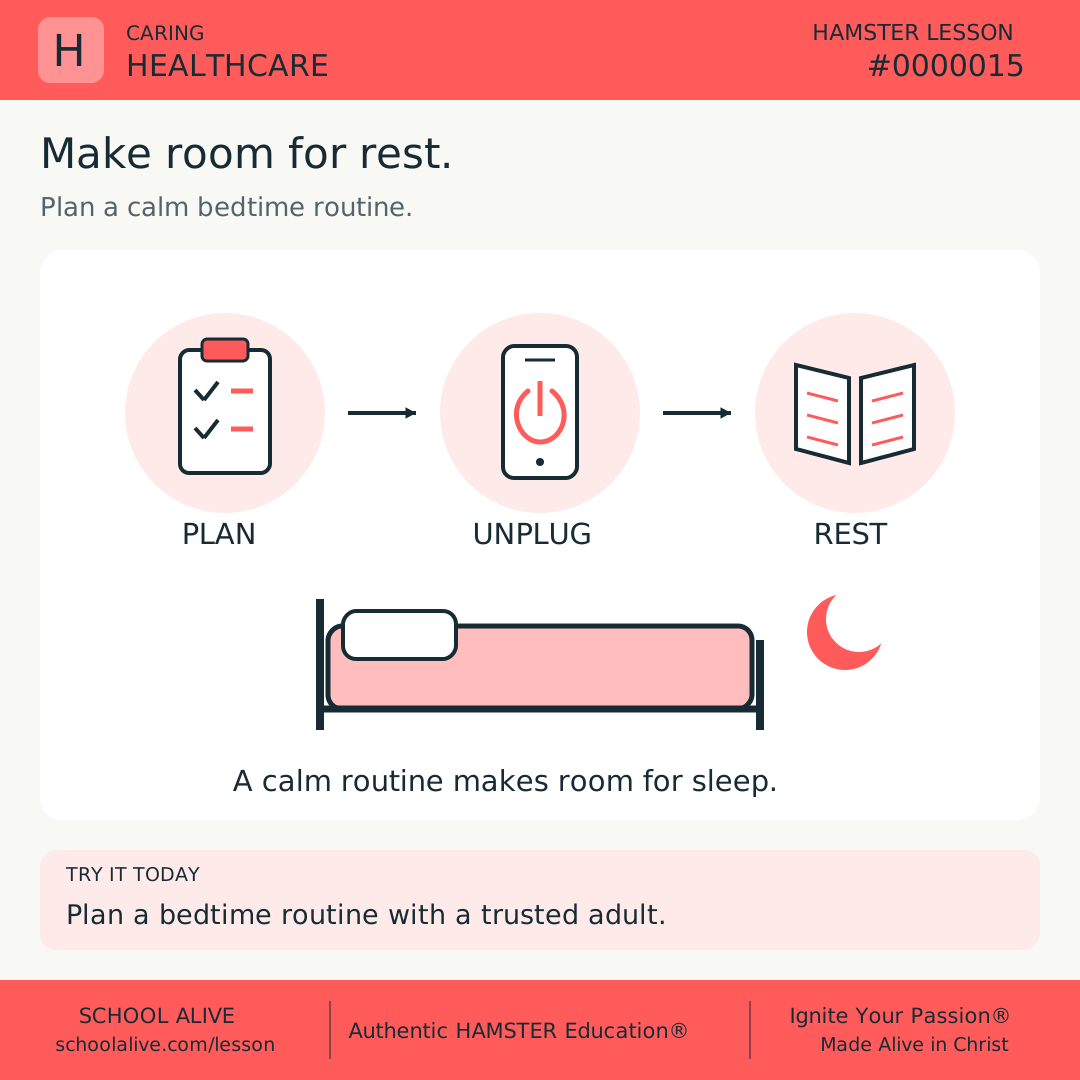
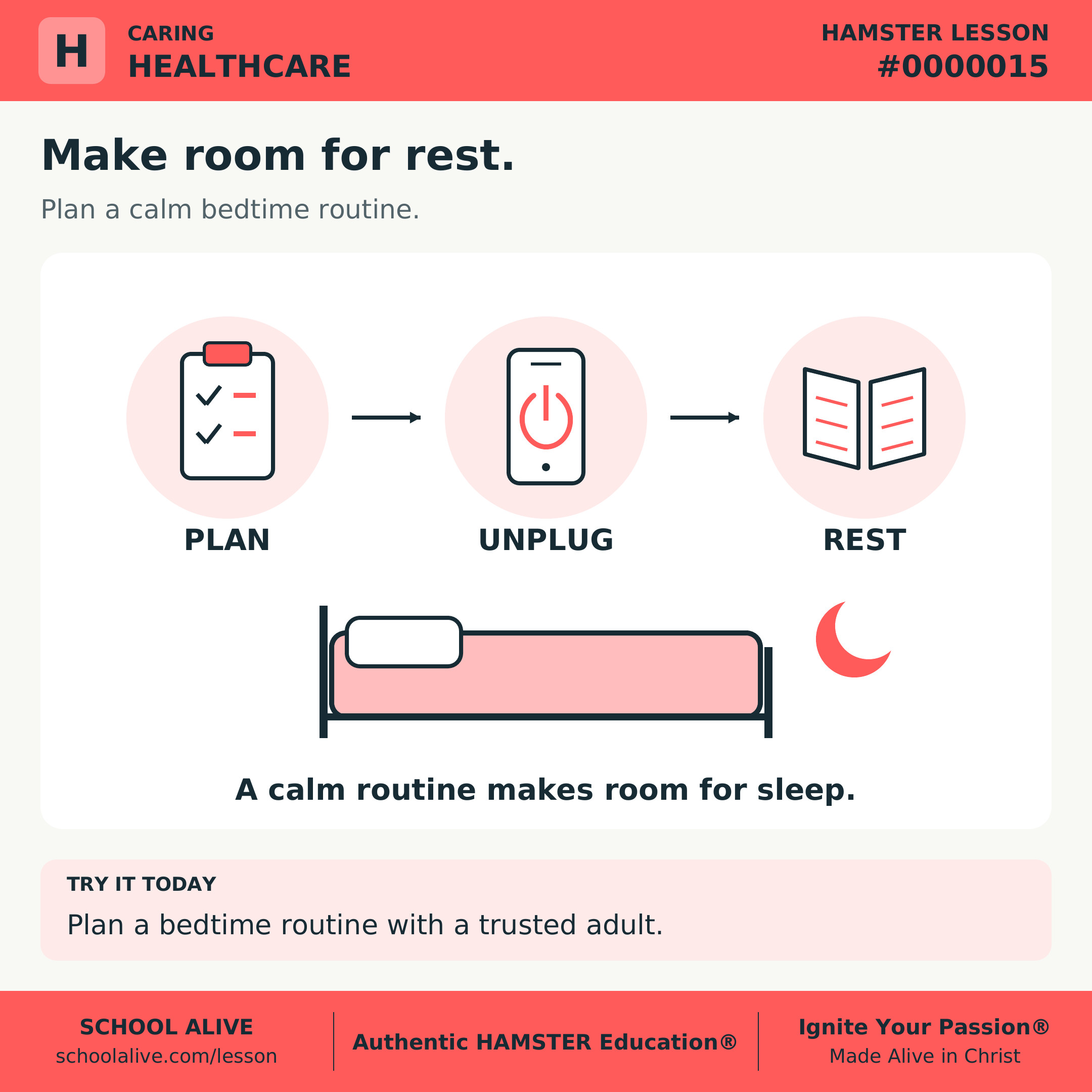
With a trusted adult, agree on a bedtime. Put screens away an hour before bed, prepare what you need for tomorrow, and choose a quiet activity such as reading.
 With a trusted adult, agree on a bedtime. Put screens away an hour before bed, prepare what you need for tomorrow, and choose a quiet activity such as reading.
Insight
Being in bed and being asleep are not the same. A calm routine makes room for sleep, but it cannot force us to fall asleep instantly.
 Being in bed and being asleep are not the same. A calm routine makes room for sleep, but it cannot force us to fall asleep instantly.
Connection
In Healthcare, caring includes everyday habits that support well-being. Families can help by protecting quiet time and making plans that fit their needs.
 In Healthcare, caring includes everyday habits that support well-being. Families can help by protecting quiet time and making plans that fit their needs.
Challenge
Tonight, make a three-step plan with a trusted adult: put screens away, prepare for tomorrow, and read quietly before bed. Try it once and discuss what made the routine easier.
 Tonight, make a three-step plan with a trusted adult: put screens away, prepare for tomorrow, and read quietly before bed. Try it once and discuss what made the routine easier.
Dive deeper
Context
Sleep is an active part of daily life. A bedtime routine is a practical way to reserve time for it, with a caregiver’s help. It is not a competition or a test of someone’s character.
Understand the idea
During sleep, the body continues important work. Sleep supports learning, memory, growth, and physical health. Staying still while awake does not provide all the same benefits, so a quiet day does not remove the need for sleep.
Children and teenagers need different amounts of sleep as they grow. A trusted adult can help plan a consistent bedtime and waking time appropriate to the child. The American Academy of Pediatrics recommends a screen-free hour before bed and keeping screens out of children’s bedrooms.
A useful routine is simple enough to repeat. Preparing clothes or a school bag earlier can reduce last-minute tasks; a quiet book can mark the transition toward bed. One difficult night does not mean failure. If sleep is repeatedly difficult, tell a caregiver so they can help and seek advice when needed.
Make a three-step evening card
- With a trusted adult, agree on bedtime and a time to put screens away an hour earlier.
- Draw three boxes: screens away, tomorrow’s things ready, and a quiet book before bed. Choose times that fit your family.
- Try the plan tonight. Tomorrow discuss which step helped and adjust one step together; do not score yourself by how quickly you fell asleep.
Discuss together
- Why might preparing for tomorrow earlier make bedtime calmer?
- How can a family support someone who has trouble sleeping without blaming them?
Introducing Microlessons
One idea. Seven steps. A practical discovery.
Begin with a question and a clear answer. Explore the history, an example, and a deeper insight. Connect the idea to everyday life, then put it into practice.
Read on your own or talk it through together. Each prepared edition includes a shareable image, concise text, and a one-page PDF.
How the 7 steps work
Each lesson moves from curiosity to understanding to practical action. Here is what each step contributes.
Question
Opens a question worth exploring and gives the lesson a clear purpose.
Answer
Gives a clear starting point that the rest of the lesson helps us understand.
History
Shows how people encountered the idea and how their discoveries shaped what we know.
Example
Makes the idea concrete through a situation, demonstration, or worked example.
Insight
Draws out the deeper principle so we understand why the idea matters.
Connection
Connects the idea to other disciplines, our faith, and everyday life.
Challenge
Turns understanding into action through something to try, practice, or explain.