
Lesson
Show depth with value.
AColorful ArtUse three values to suggest the form of a simple object.
Value in art · Notice light and shadow, then use them in a drawing.
Question
How can a pencil drawing look solid when the paper is flat?
 How can a pencil drawing look solid when the paper is flat?
Answer
Use value: how light or dark an area appears. Different values can suggest surfaces facing toward or away from a light.
 Use value: how light or dark an area appears. Different values can suggest surfaces facing toward or away from a light.
History
Gerrit van Honthorst’s painting Christ Crowned with Thorns, made about 1620, uses a candlelit scene. Getty highlights how light and dark colors suggest the light source and surrounding darkness.
 Gerrit van Honthorst’s painting Christ Crowned with Thorns, made about 1620, uses a candlelit scene. Getty highlights how light and dark colors suggest the light source and surrounding darkness.
Example
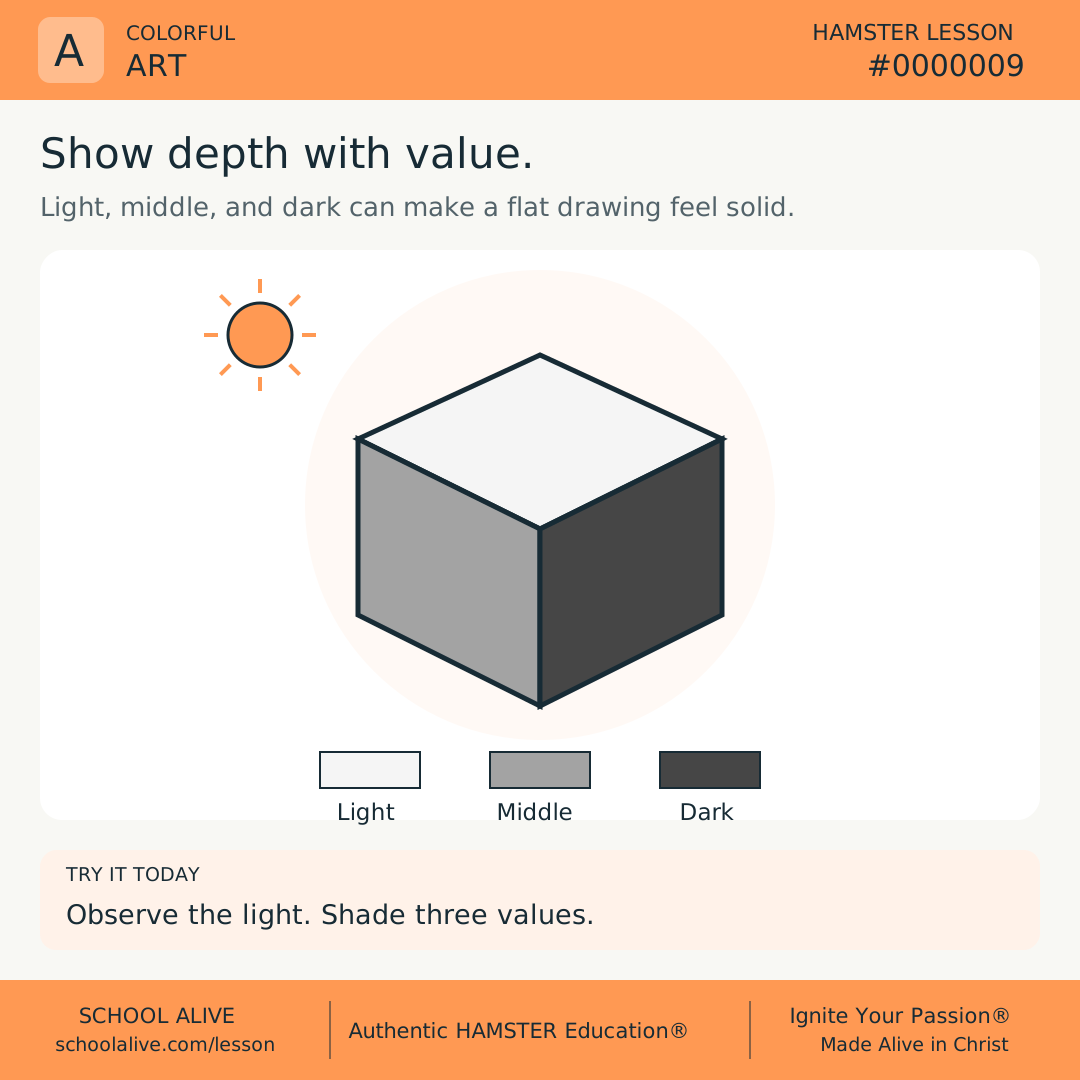
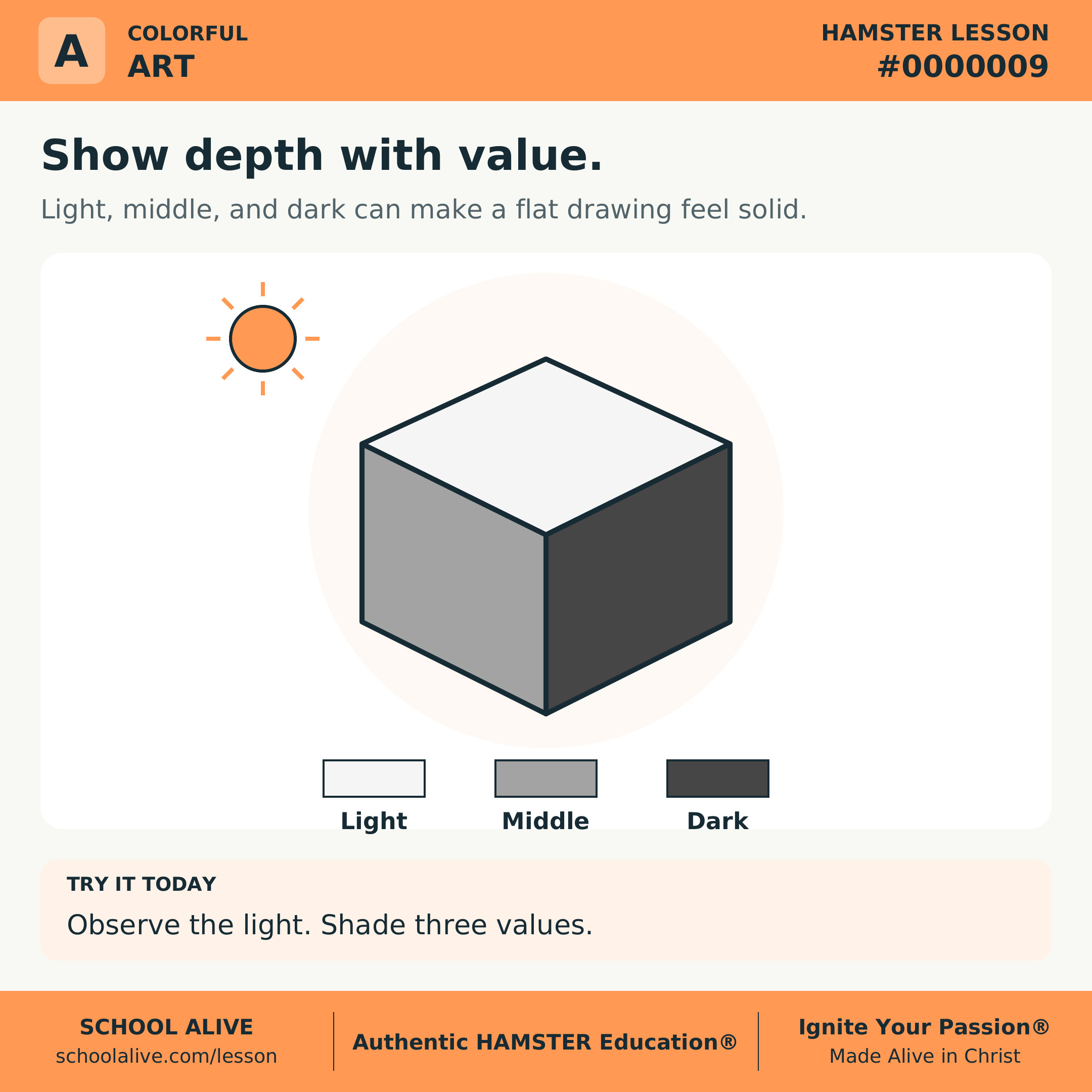
Place a plain box near a lamp. Its faces may look different even when they are the same color. Draw the visible faces with light, middle, and dark shading.
 Place a plain box near a lamp. Its faces may look different even when they are the same color. Draw the visible faces with light, middle, and dark shading.
Insight
Value is different from hue, the name of a color. You can show depth using only one pencil; observe the light rather than making every face equally dark.
 Value is different from hue, the name of a color. You can show depth using only one pencil; observe the light rather than making every face equally dark.
Connection
Illustrators, photographers, and designers use differences in value to help people notice forms and important details. Clear light-dark differences can also make lettering easier to see.
 Illustrators, photographers, and designers use differences in value to help people notice forms and important details. Clear light-dark differences can also make lettering easier to see.
Challenge
Draw three connected faces of a box. Leave one light, shade one medium, and shade one dark to match a real box under a lamp. Point out the light source and explain your choices.
 Draw three connected faces of a box. Leave one light, shade one medium, and shade one dark to match a real box under a lamp. Point out the light source and explain your choices.
Dive deeper
Context
A drawing is flat, but artists can suggest three-dimensional form through shape, perspective, and shading. This lesson focuses on value, the lightness or darkness we see.
Understand the idea
Compare a box in steady light. The faces have the same material, but they do not receive the same illumination. Choose three values that make their differences clear; these are a simplified study, not a rule that every object has exactly three tones.
Color name and value answer different questions. Hue asks which color; value asks how light or dark. A grayscale drawing removes hue so we can concentrate on light and shadow.
Observe before shading. A cast shadow falls on another surface where an object blocks light; shading on the object describes its own surfaces. Keep the light direction consistent, and change your drawing if your observations disagree with your first guess.
One box, three values
- Place a plain box on a table under an ordinary lamp. Keep paper away from hot bulbs. Look for the lightest and darkest visible faces.
- Draw three touching squares on scrap paper. Leave the first almost white, shade the second gray, and make the third darker without tearing the paper.
- Sketch the box and use the three values on its faces. Move the lamp, observe again, and explain which faces would need different shading.
Discuss together
- Could an orange surface look lighter than a blue one? What information would you need?
- If you move the lamp to the opposite side, what changes and what stays the same?
Introducing Microlessons
One idea. Seven steps. A practical discovery.
Begin with a question and a clear answer. Explore the history, an example, and a deeper insight. Connect the idea to everyday life, then put it into practice.
Read on your own or talk it through together. Each prepared edition includes a shareable image, concise text, and a one-page PDF.
How the 7 steps work
Each lesson moves from curiosity to understanding to practical action. Here is what each step contributes.
Question
Opens a question worth exploring and gives the lesson a clear purpose.
Answer
Gives a clear starting point that the rest of the lesson helps us understand.
History
Shows how people encountered the idea and how their discoveries shaped what we know.
Example
Makes the idea concrete through a situation, demonstration, or worked example.
Insight
Draws out the deeper principle so we understand why the idea matters.
Connection
Connects the idea to other disciplines, our faith, and everyday life.
Challenge
Turns understanding into action through something to try, practice, or explain.