
Lesson
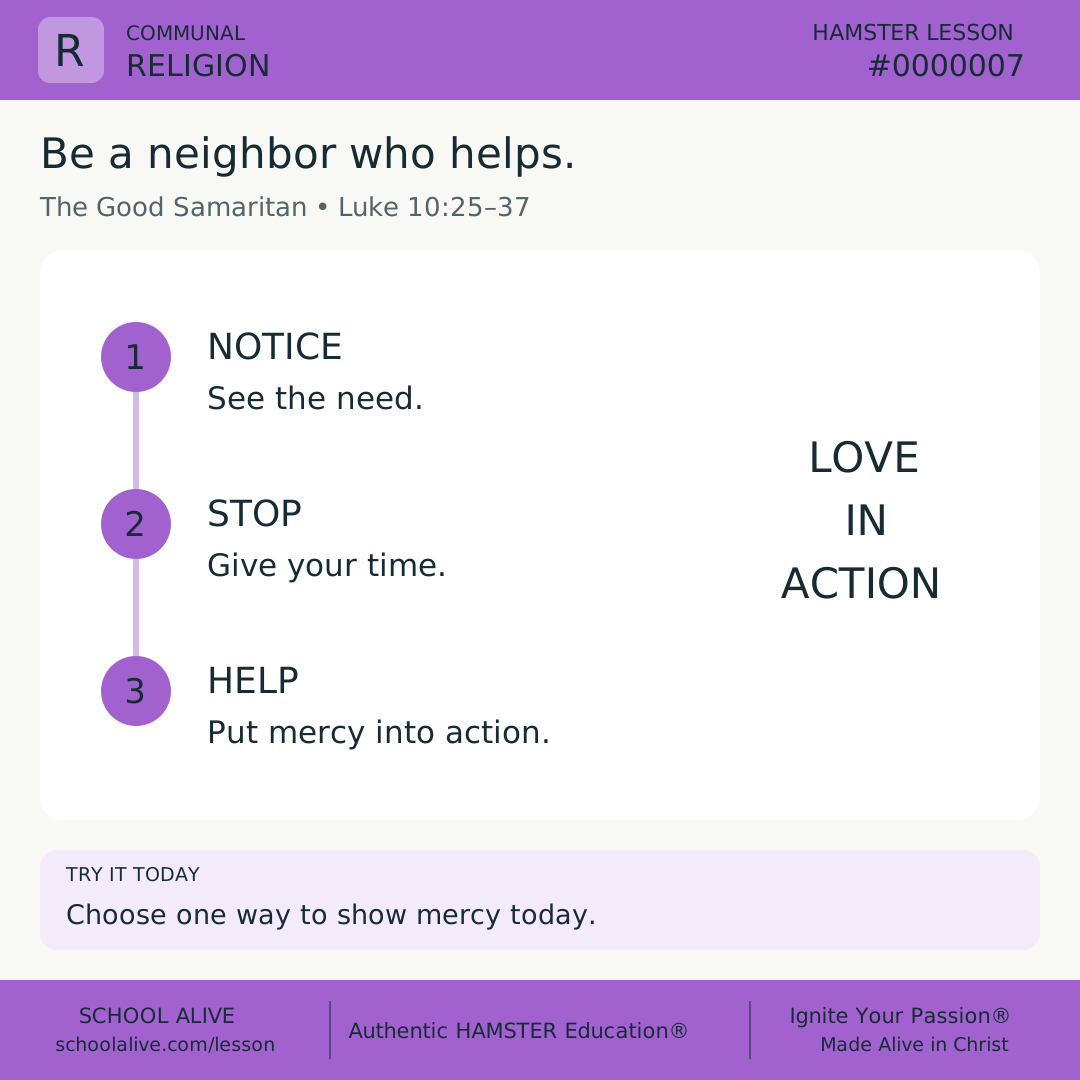
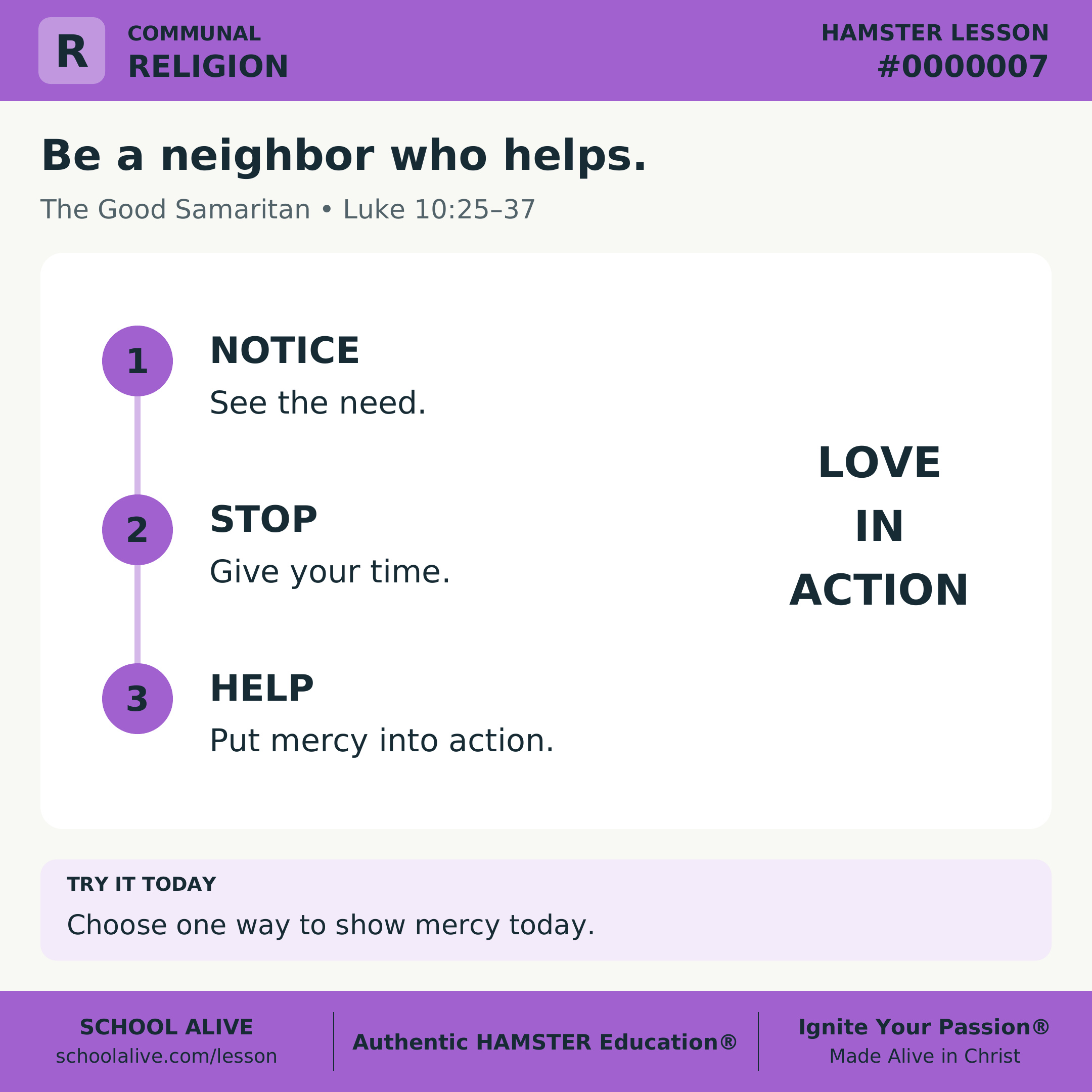
Be a neighbor who helps.
RCommunal ReligionTurn compassion into practical care for a neighbor.
Biblical understanding · Explore Jesus’ parable of the Good Samaritan and what it teaches about loving our neighbors.
Question
What does it mean to love our neighbor?
 What does it mean to love our neighbor?
Answer
Jesus teaches us to show mercy through action. In the parable of the Good Samaritan, a traveler cares for a wounded man whom others have passed by.
 Jesus teaches us to show mercy through action. In the parable of the Good Samaritan, a traveler cares for a wounded man whom others have passed by.
History
Luke 10:25-37 records Jesus answering a teacher of the law who asked, "Who is my neighbour?" The parable challenged him to consider what acting as a neighbor requires.
 Luke 10:25-37 records Jesus answering a teacher of the law who asked, "Who is my neighbour?" The parable challenged him to consider what acting as a neighbor requires.
Example
The Samaritan stops, tends the man’s wounds, brings him to shelter, and provides for his care. His compassion costs him time, effort, and money.
 The Samaritan stops, tends the man’s wounds, brings him to shelter, and provides for his care. His compassion costs him time, effort, and money.
Insight
Jesus turns the discussion toward becoming a neighbor to the person in need. Knowing the right answer matters, but His lesson calls us to put mercy into practice.
 Jesus turns the discussion toward becoming a neighbor to the person in need. Knowing the right answer matters, but His lesson calls us to put mercy into practice.
Connection
We can live this out in our homes, churches, and communities. We can notice someone who is lonely, help with a burden, or serve a person who cannot repay us. Faith in Christ should bear fruit in the way we love.
 We can live this out in our homes, churches, and communities. We can notice someone who is lonely, help with a burden, or serve a person who cannot repay us. Faith in Christ should bear fruit in the way we love.
Challenge
Read Luke 10:25-37 together. Choose one need you can help meet today. Make a simple plan and carry it out. Afterward, explain which of the Samaritan's actions helped you decide how to show mercy.
 Read Luke 10:25-37 together. Choose one need you can help meet today. Make a simple plan and carry it out. Afterward, explain which of the Samaritan's actions helped you decide how to show mercy.
Dive deeper
Context
In Luke 10:25–37, a teacher of the law asks Jesus about eternal life and then asks who counts as his neighbor. Jesus answers with a story that ends by asking which traveler acted as a neighbor to the wounded man.
Understand the idea
Follow the Samaritan’s actions: he notices suffering, feels compassion, approaches, tends wounds, provides transport, and arranges continued care. Mercy becomes concrete through time, attention, and resources.
Jesus redirects the discussion from drawing a boundary around whom we must love to becoming a neighbor who shows mercy. The passage calls us to respond, not merely admire a good example. Christian service expresses love for God and neighbor; it is not a way to purchase God’s grace.
Try planning practical mercy
- Read Luke 10:25–37 and list the Samaritan’s specific actions.
- Choose an ordinary need at home, school, or church. Ask what help would actually be useful, and plan one action within your ability.
- Carry it out with appropriate guidance. Reflect on whether you listened, followed through, and treated the person with dignity.
Discuss together
- How does Jesus’ final question change the teacher’s original question?
- What is the difference between noticing a need and taking responsibility for one helpful next step?
Introducing Microlessons
One idea. Seven steps. A practical discovery.
Begin with a question and a clear answer. Explore the history, an example, and a deeper insight. Connect the idea to everyday life, then put it into practice.
Read on your own or talk it through together. Each prepared edition includes a shareable image, concise text, and a one-page PDF.
How the 7 steps work
Each lesson moves from curiosity to understanding to practical action. Here is what each step contributes.
Question
Opens a question worth exploring and gives the lesson a clear purpose.
Answer
Gives a clear starting point that the rest of the lesson helps us understand.
History
Shows how people encountered the idea and how their discoveries shaped what we know.
Example
Makes the idea concrete through a situation, demonstration, or worked example.
Insight
Draws out the deeper principle so we understand why the idea matters.
Connection
Connects the idea to other disciplines, our faith, and everyday life.
Challenge
Turns understanding into action through something to try, practice, or explain.